

Waides Feed
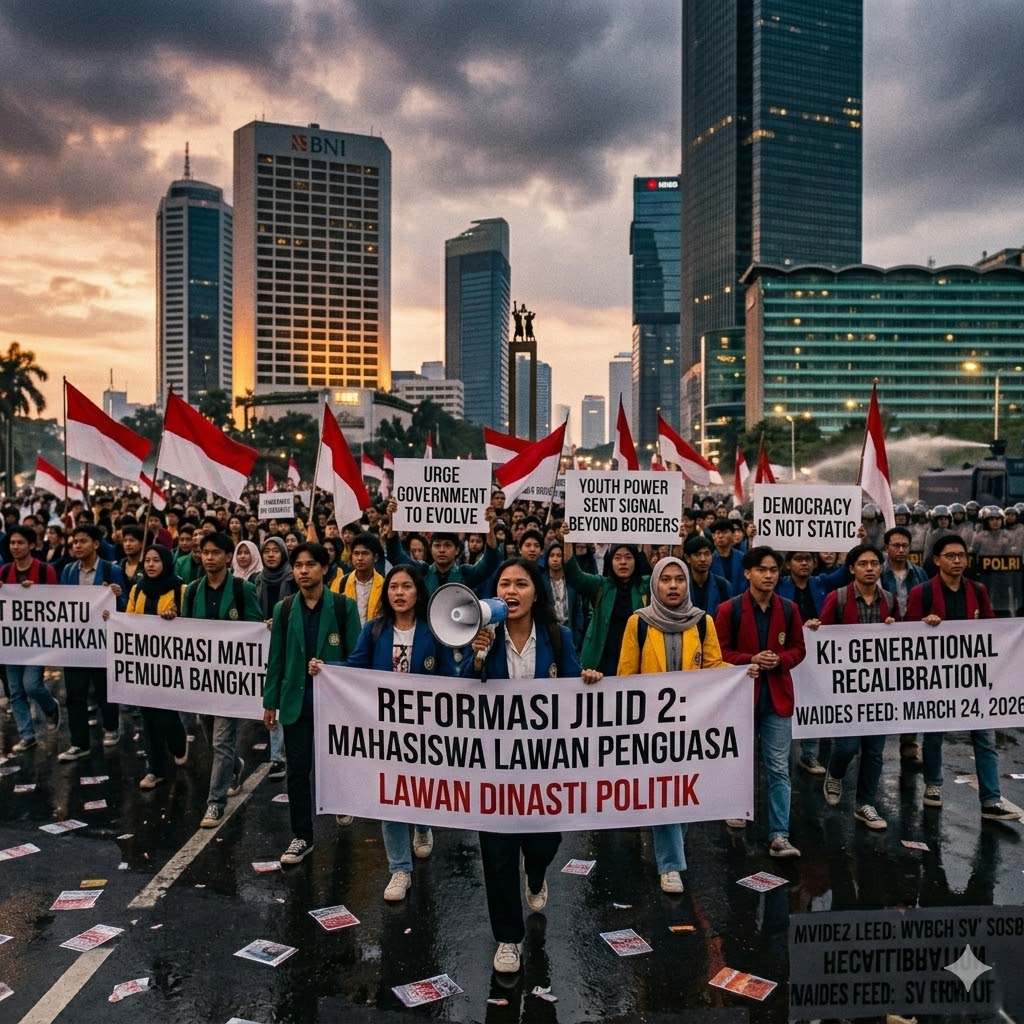
On March 24, 2026, Indonesia is witnessing a surge of student-led protests across major cities including Jakarta, Yogyakarta, and Bandung, as thousands of young people take to the streets to challenge newly proposed government policies.
The demonstrations are largely driven by opposition to controversial legislative moves linked to governance reforms, economic management, and perceived elite consolidation of power. Students and civil groups argue that these changes risk weakening democratic safeguards and prioritizing political interests over public welfare.
What began as campus mobilizations has now evolved into a nationwide expression of civic resistance, echoing Indonesia’s long history of youth-led movements that have shaped its political direction.
Security forces have been deployed in key areas, while authorities urge calm. Yet the energy on the ground suggests something deeper than policy disagreement—it reflects a generational demand for accountability, transparency, and inclusion in national decision-making.
Why It Matters / Public Context
Indonesia is not just any country—it is Southeast Asia’s largest economy and one of the world’s most important democracies.
When its youth mobilize, it sends a signal far beyond its borders.
This moment highlights a recurring global pattern:
Young populations are increasingly unwilling to remain passive in political systems that affect their future.
From economic pressures to governance concerns, today’s youth are more informed, connected, and organized than ever before. Social media has amplified their voices, turning local protests into global conversations within hours.
For the general public, this is a reminder that democracy is not static, it is constantly negotiated between power and the people.
For Africa and Global Systems
For Africa, Indonesia’s situation carries a familiar resonance.
Many African nations also have:
- Large, youthful populations
- Growing economic pressures
- Increasing demand for transparent governance
Indonesia becomes a mirror, a signal of what happens when youth engagement reaches a tipping point.
Globally, this reflects a broader shift:
Governments are being challenged not just by opposition parties, but by citizens themselves especially the younger generation.
The future of governance is no longer top-down.
It is increasingly participatory—or contested.
KI Analysis (Konsmik Intelligence)
According to KI analysis, this is not just protest, it is generational recalibration.
Opportunities
- Strengthening of democratic accountability through civic participation
- Emergence of new political voices and leadership pipelines
- Increased pressure for transparent and inclusive policy-making
- Global awareness and solidarity around governance issues
Risks
- Escalation into clashes between protesters and security forces
- Political instability affecting economic confidence and investment
- Potential suppression of dissent, leading to deeper societal divisions
- Short-term disruption to public order and daily life
The deeper insight:
When youth energy is ignored, it becomes resistance.
When it is engaged, it becomes transformation.
Konsmik Reality (From the Lens of Konsmik Reality)
Historical Pattern
Indonesia’s history shows that student movements have been catalysts for major political change most notably during the 1998 Reformasi movement that reshaped the nation’s democracy.
Youth movements are rarely isolated events.
They are early signals of systemic shifts.
Forecast
Short-Term (1–2 years)
- Continued protests and negotiations between government and civil groups
- Possible revisions or delays of controversial policies
- Heightened political awareness among young citizens
Medium-Term (3–5 years)
- Emergence of youth-driven political influence in elections and policy debates
- Institutional adjustments to accommodate public pressure
- Strengthening or testing of democratic resilience
Long-Term (5–10 years)
- Transformation of political culture toward greater civic participation
- A new generation of leaders shaped by this moment
- Redefinition of governance in Indonesia as more responsive and transparent
Reflection Question
- When young people rise to challenge power, is it instability or the beginning of renewal?
- Are governments prepared to evolve with their people or risk being reshaped by them?
#WaidesNiuz #KonsmikIntelligence #Indonesia #YouthPower #Democracy #GlobalAffairs #Society













Leave a Reply