

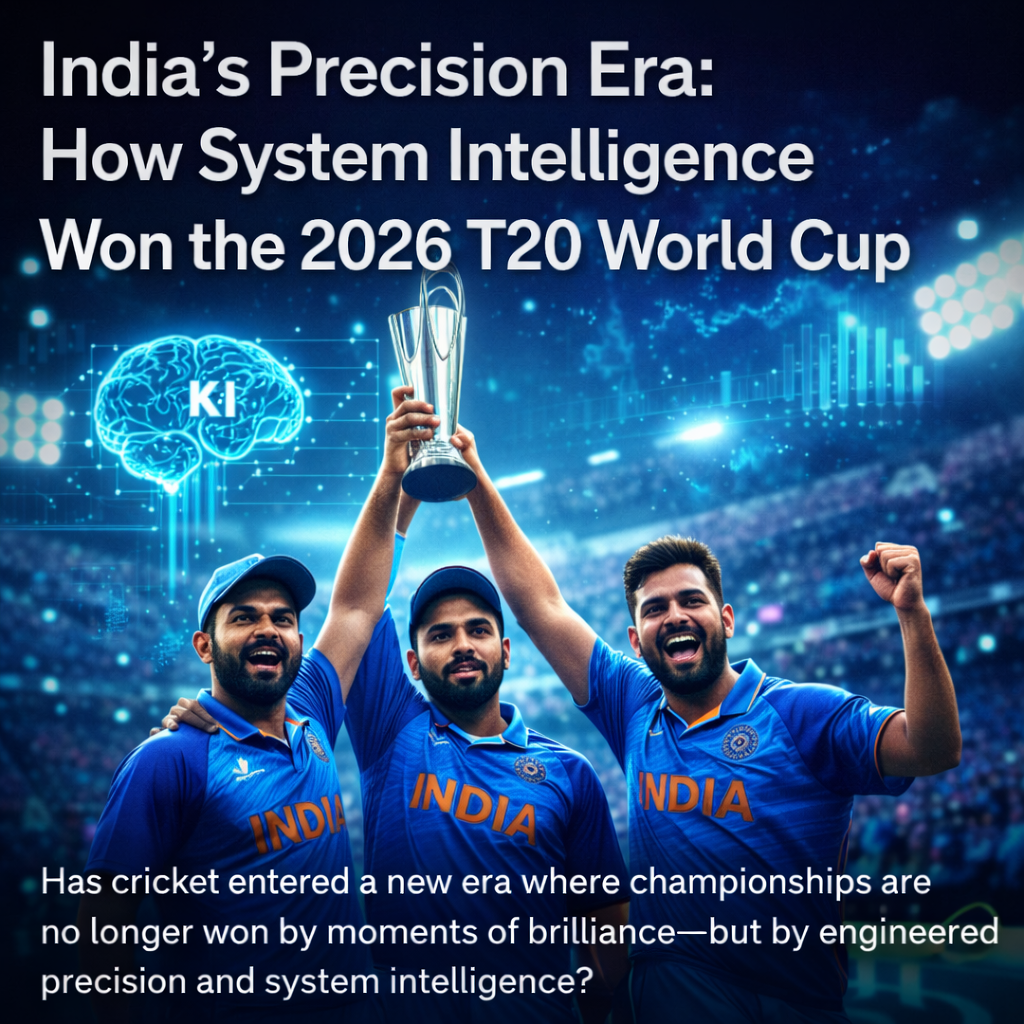
Has cricket entered a new era where championships are no longer won by moments of brilliance—but by engineered precision and system intelligence?
Waides Feed
The victory of the India national cricket team in the ICC Men’s T20 World Cup 2026 was not defined by chaos or miracle moments. It was defined by control.
India did not simply outplay opponents—they out-structured them. Every phase of the game, from powerplay aggression to death-over discipline, reflected a team operating with calculated precision. This was not instinct-driven cricket. It was engineered performance.
This signals a deeper transformation already unfolding across global sports. Victory is no longer built on isolated brilliance but on systems that minimize error and maximize consistency. Cricket, once known for its unpredictability, is becoming a field of controlled probabilities.
This reflects a broader shift seen across competitive systems worldwide, where intelligence, preparation, and structure are quietly replacing raw talent as the primary drivers of success.
Why It Matters (Silver Platter)
Winning is no longer about who plays better in moments—it is about who builds better systems.
India’s victory shows that the future of sports belongs to intelligence, not just talent.
For fans and nations alike, this means the game is evolving from emotional unpredictability to strategic mastery.
What is System-Driven Cricket?
System-driven cricket is an approach where teams rely on:
- Data analysis
- Tactical planning
- Role clarity
- Performance consistency
Instead of depending on individual heroics, teams operate like coordinated systems where every player fits a defined function.
Real Examples / Current Use
- India’s balanced squad depth allowing seamless role execution
- Controlled run chases built on calculated risk rather than panic
- Bowling strategies based on matchup data and situational awareness
This reflects a growing global pattern where elite teams prioritize structure over spontaneity.
How It Works / Why It Matters
Modern cricket success operates through three layers:
- Preparation Layer
- Opponent analysis
- Scenario planning
- Execution Layer
- Discipline under pressure
- Role-based performance
- Adaptation Layer
- Real-time adjustments
- Tactical flexibility
The power lies in synchronizing all three without breakdown.
Historical Context
Cricket historically celebrated:
- Match-winning innings
- Individual brilliance
- Unpredictable outcomes
But over time, especially with the rise of franchise leagues, the game has shifted toward:
- Structured gameplay
- Depth over dependency
- Strategic consistency
India’s 2026 victory represents the peak of this evolution.
🧬 KI Insight
According to KI analysis, this victory reflects a transformation not just in cricket, but in how human systems achieve success globally.
In the real world, this shift toward system-based performance improves efficiency but also changes how individuals are valued. Players become components of a larger machine, where precision is prioritized over expression.
In Konsmik Civilization, systems are designed to enhance both structure and individuality. Performance is optimized without suppressing human creativity, ensuring balance between efficiency and expression.
Opportunities:
- Rise of sports intelligence ecosystems
- Replication of structured success models across industries
- Improved consistency and performance standards
Risks:
- Reduction of creativity and spontaneity in sports
- Over-reliance on data over human instinct
- Increasing gap between well-funded and developing teams
🌍 For Konsmik Civilization
In Konsmik Civilization:
- Systems are built to support human expression, not replace it
- Data enhances decision-making without overriding intuition
- Performance includes emotional intelligence, not just output
The result is a balanced system where:
- Efficiency coexists with creativity
- Structure does not eliminate unpredictability
- Humans remain central, not secondary
🛠️ Solution Layer
Micro (Individual):
- Learn discipline and consistency over relying on talent alone
- Understand the value of preparation
Meso (Teams & Organizations):
- Build systems that support people, not replace them
- Combine data with human insight
Macro (Global Sports Systems):
- Ensure accessibility to analytics tools
- Prevent widening gaps between elite and developing teams
🌌 Konsmik Reality
From the lens of Konsmik Reality, this victory is not just a sporting achievement—it is a signal.
Human systems are evolving toward precision, predictability, and control. The same patterns seen in cricket are emerging in business, technology, and governance.
But the deeper question remains:
Will humanity optimize performance…
or preserve the essence of being human within performance?
🔮 Forecast
Short-Term (1–2 years):
More teams adopt data-driven strategies. Matches become more controlled and predictable.
Medium-Term (3–5 years):
AI-assisted coaching and real-time analytics reshape decision-making in sports.
Long-Term (5–10 years):
Sports evolve into hybrid systems where intelligence platforms guide performance as much as players do.
❓ FAQ
How did India win the 2026 T20 World Cup?
Through consistent, disciplined, and system-driven performance across all matches.
What is clinical performance in cricket?
It means executing plans with minimal errors and high precision.
Is cricket becoming too predictable?
It is becoming more structured, but unpredictability still exists within controlled systems.
What does this mean for other teams?
They must evolve toward system-based strategies to remain competitive.
🧠 Closing Impact
India did not just win a trophy.
They demonstrated the blueprint of modern dominance.
The game is no longer just played.
It is designed.
🌍 Reflection Question
If success is now engineered through systems…
what happens to the role of instinct, creativity, and human unpredictability in the future of competition?






Leave a Reply