

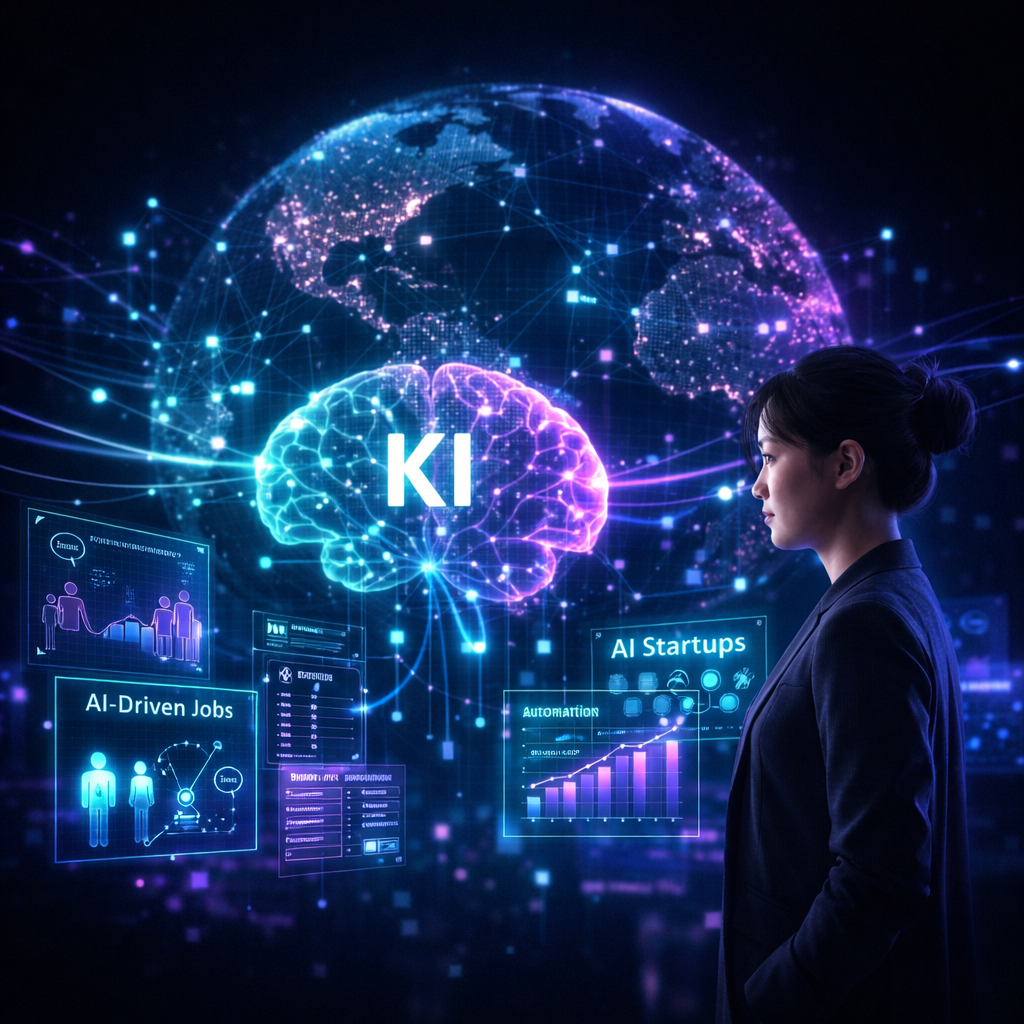
What if the biggest change to jobs is not unemployment… but transformation you don’t even notice?
Across Asia and the world, AI startups are quietly reshaping how work is done, who does it, and what it means to have a job at all. This is not a sudden collapse of employment. It is something deeper. A restructuring happening inside everyday systems.
🧠 Waides Feed
The rise of AI startups is not just a technological trend. It is a systemic shift in how human effort is converted into value.
Companies building on advanced AI systems are no longer focused on replacing entire jobs at once. Instead, they are breaking work into smaller units, automating tasks, and rebuilding roles around intelligent systems. This reflects a broader transformation already unfolding across global economies, where productivity is no longer tied strictly to human labor.
In regions like Asia, where large populations support labor-intensive industries, this shift carries both promise and pressure. Businesses are adopting AI not just for innovation, but for survival in a globally competitive environment.
At the center of this movement are companies like OpenAI and Google DeepMind, whose technologies are powering a new generation of startups capable of scaling faster, operating leaner, and producing more with fewer people.
This connects to a deeper pattern. Work is no longer about execution alone. It is about direction, coordination, and understanding systems.
The future is not built by effort alone, but by those who understand how to guide intelligence.
⚖️ Why It Matters / Public Context
Jobs are not simply disappearing. They are being restructured into something new.
Those who adapt will gain leverage. Those who don’t may feel replaced without understanding why.
For individuals:
- Tasks you once did manually may become automated
- New roles will require working alongside AI
- Stability will depend on adaptability
🤖 What Is AI Job Transformation?
AI job transformation refers to how artificial intelligence changes the structure of work rather than just eliminating jobs.
Instead of replacing entire professions, AI:
- Automates repetitive tasks
- Assists with complex thinking
- Enhances productivity
This creates hybrid roles where humans and AI work together.
🌐 Real Examples / Current Use
The change is already visible:
- Customer support roles shifting to AI-assisted systems
- Developers using AI copilots to write and debug code faster
- Content creators leveraging AI for writing, design, and editing
- Financial analysts using AI to process large datasets instantly
Across Asia, startups are using AI to manage large-scale operations with smaller teams. This reflects a broader shift where businesses prioritize efficiency and scalability over workforce size.
⚙️ How It Works / Why It Matters
AI startups operate by restructuring work into three layers:
- Task Breakdown
Jobs are divided into smaller, repeatable units - AI Integration
Intelligent systems handle predictable or data-heavy tasks - Human Oversight
Humans guide, refine, and make strategic decisions
This model creates a new reality:
- Fewer people can produce more output
- Skills shift from execution to supervision
- Value moves from effort to intelligence
🕰️ Historically…
Every economic shift has redefined work:
- Industrial era reduced manual labor
- Digital era reduced information barriers
- AI era is reducing cognitive workload
But unlike previous transitions, this shift is happening rapidly and globally at the same time.
🧬 KI Insight
According to KI analysis, the transformation of jobs by AI startups is not accidental. It is driven by economic pressure, technological capability, and global competition.
Opportunities:
- Creation of new roles focused on managing and guiding AI
- Increased productivity and earning potential
- Access to global work opportunities regardless of location
Risks:
- Gradual displacement of repetitive roles
- Growing gap between AI-skilled and non-AI-skilled workers
- Psychological impact of shifting job identity
From a human-centered perspective, the deeper issue is not job loss alone, but the changing meaning of work in people’s lives.
🌍 For Konsmik Civilization
In Konsmik Civilization, work is not defined by tasks, but by purpose and contribution.
AI is integrated to:
- Reduce unnecessary labor
- Enhance human creativity and decision-making
- Ensure balance between efficiency and human well-being
This creates a system where individuals are not replaced by technology, but elevated by it.
🛠️ Solution Layer
Micro (Individual)
- Learn AI tools relevant to your field
- Focus on skills that AI cannot easily replace (creativity, strategy, emotional intelligence)
Meso (Business)
- Redesign roles to integrate AI rather than replace workers entirely
- Invest in employee reskilling
Macro (Global Systems)
- Governments must invest in education reform
- Create policies to support workforce transition
🌌 Konsmik Reality
From a Konsmik perspective, this shift reveals something deeper.
Work has always been tied to survival. Now, it is moving toward alignment with intelligence.
The question is no longer:
“What job do you do?”
But:
“How do you interact with intelligence systems?”
This is a transformation not just of economies, but of identity.
🔮 Forecast
Short-term (1–2 years):
Widespread adoption of AI tools in workplaces with minimal immediate job loss
Medium-term (3–5 years):
Significant restructuring of job roles and increased demand for AI-related skills
Long-term (5–10 years):
Emergence of intelligence-driven work systems where human roles focus on direction, creativity, and strategy
❓ FAQ
Will AI completely replace jobs?
No. Most jobs will change rather than disappear entirely.
Which jobs are most at risk?
Repetitive, predictable, and data-heavy roles.
What skills will be important?
Critical thinking, creativity, communication, and AI literacy.
Why is this important for Asia?
Because of large workforces, the impact of AI could be both transformative and disruptive.
🧠 Closing Impact
This is not just a technological shift.
It is a redefinition of what it means to work, to earn, and to contribute in a world where intelligence is no longer limited to humans.
🌍 Reflection Question
If AI can perform most tasks, what will define your value in the future?
Will you compete with intelligence… or learn how to guide it?










Leave a Reply