

The New Global Arms Race Has No Missiles
Across the world, governments are investing billions into artificial intelligence.
But unlike traditional arms races, this one is not about nuclear weapons, tanks, or aircraft carriers.
It is about control of intelligence itself.
Artificial intelligence is rapidly becoming the infrastructure behind:
- military strategy
- financial markets
- scientific discovery
- economic productivity
- global information systems
The nation that leads in AI will not simply gain technological advantage.
It may gain civilizational influence over the future of knowledge and decision-making.
And that race is already underway.
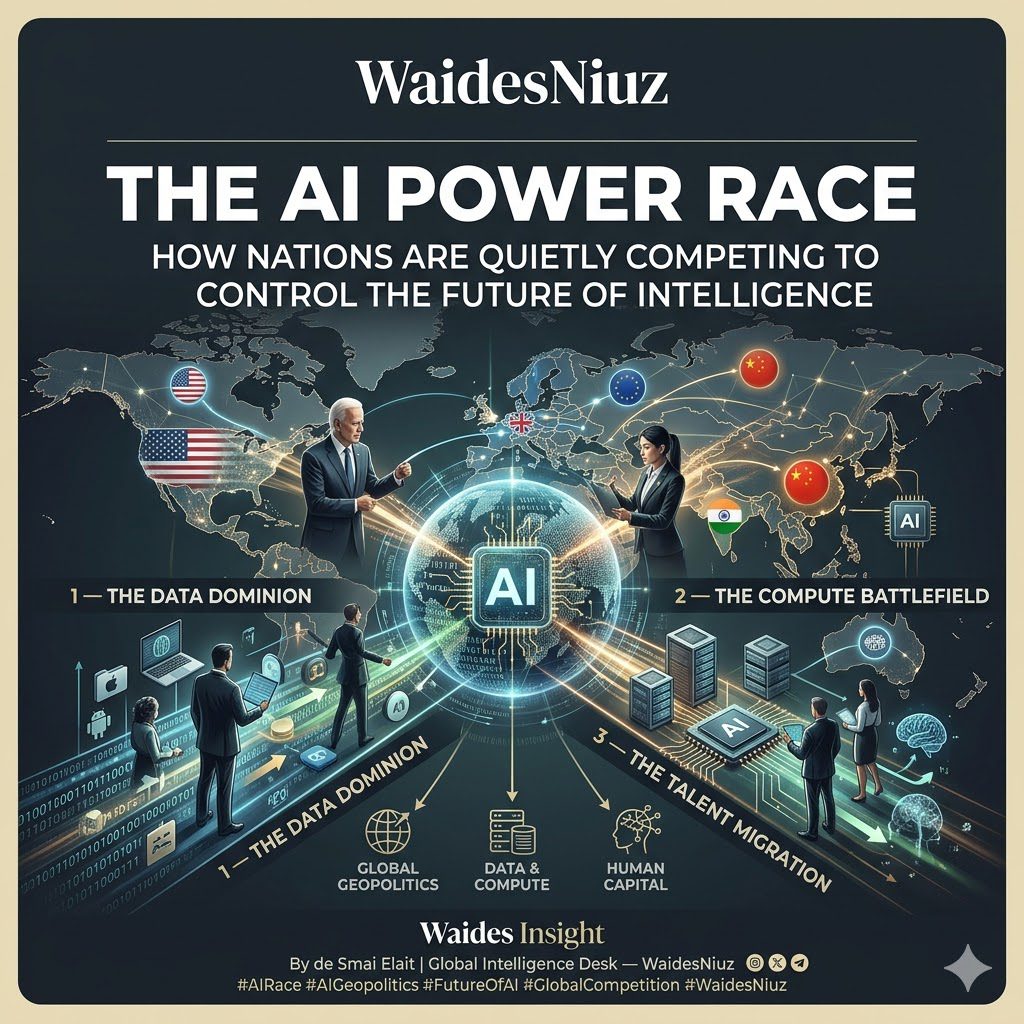
Three Frontlines of the Global AI Race
1 — The Data Dominion
Artificial intelligence feeds on data.
The more data a nation or corporation controls, the stronger its AI systems become.
Today, large technology platforms collect vast amounts of information from billions of users worldwide.
This data advantage allows AI models to improve faster and learn more complex behaviors.
In many ways, data has become the new natural resource of the digital age.
The countries and companies that control it may hold enormous influence over future technological development.
2 — The Compute Battlefield
Training powerful AI systems requires enormous computing power.
Massive data centers filled with advanced graphics processors and specialized AI chips are now critical national infrastructure.
Because of this, governments are investing heavily in:
- supercomputing facilities
- advanced semiconductor manufacturing
- large-scale cloud infrastructure
Without sufficient computing capacity, even the best algorithms cannot compete.
In the modern intelligence race, compute power is the engine of innovation.
3 — The Talent Migration
Perhaps the most important battlefield is human intelligence itself.
AI development depends on highly skilled researchers, engineers, and scientists.
Countries are now competing aggressively to attract global talent through:
- research funding
- university programs
- startup ecosystems
- immigration incentives
The future of artificial intelligence may ultimately depend on where the world’s most brilliant minds decide to build.
🧬 According to KI Analysis
Within the analytical framework of Konsmik Intelligence, the global AI race raises deeper questions about how humanity organizes knowledge and power.
Key KI Observations
1 — Is AI a tool or a new form of power?
AI is rapidly becoming both. Whoever controls advanced intelligence systems may influence global decision-making.
2 — Will AI concentrate wealth further?
Without balanced systems, AI productivity gains could concentrate economic power among a small number of technology actors.
3 — Can AI replace human creativity?
Not entirely. AI can amplify intelligence, but human imagination remains the origin of new ideas.
4 — Why are governments investing so heavily?
Because AI may shape the next era of economic and geopolitical dominance.
5 — Could AI destabilize labor markets?
Yes. Automation may transform industries faster than societies can adapt.
6 — Can AI be governed globally?
Currently, there is no unified global framework to regulate advanced AI systems.
7 — Is AI development accelerating?
Yes. Breakthroughs in machine learning, hardware, and data infrastructure are compounding rapidly.
8 — Will AI reduce inequality or increase it?
That depends entirely on how access to AI tools is distributed.
9 — Could AI improve global problem-solving?
If used responsibly, AI could dramatically accelerate solutions in medicine, energy, and science.
10 — What is the real risk?
The risk is not intelligence itself, but who controls it and for what purpose.
🛡️ Waides Insight — In Konsmik Reality
From the perspective of Konsmik Reality, the global AI race reveals something deeper about humanity’s current stage of development.
Civilizations throughout history have competed over:
- land
- resources
- territory
- energy
But today, the most valuable resource is becoming intelligence itself.
The challenge humanity now faces is not simply technological.
It is philosophical.
If intelligence becomes concentrated in the hands of a few systems or institutions, the imbalance of power could grow dramatically.
But if intelligence becomes distributed and accessible, it could unlock unprecedented global creativity and prosperity.
Within the philosophy of Konsmia, intelligence should not be treated as a weapon of dominance.
It should be treated as a shared evolutionary tool for humanity.
The true future of AI will depend on whether the world chooses competition or collective advancement.
The technology itself is neutral.
The direction humanity gives it will determine whether AI becomes a force of division or a catalyst for the next stage of civilization.
The WaidesNiuz Verdict
Artificial intelligence is not just another technological breakthrough.
It is the foundation of the next global system.
Nations that lead in AI may shape the future of economics, security, and scientific discovery.
But the deeper question remains:
Will intelligence become a centralized power structure, or will it become a distributed tool for human progress?
The answer will define the world that emerges in the coming decades.
Global Reflection
If intelligence becomes the most powerful resource on Earth, who should control it, governments, corporations, or humanity as a whole?




Leave a Reply