

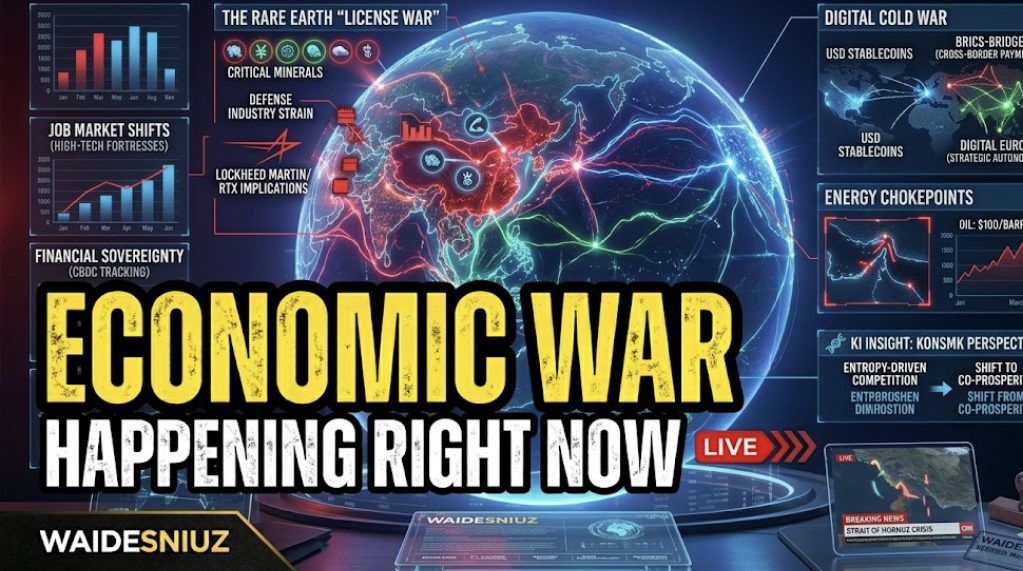
A War Most People Cannot See
Across the world, headlines show missiles, naval exercises, and political speeches.
But the most powerful conflict shaping 2026 is happening far away from battlefields.
It is happening inside:
- financial networks
- semiconductor factories
- supply chains
- digital currencies
- energy infrastructure
This is not a traditional war.
It is an economic war of systems.
And most of humanity is fighting in it without even knowing it exists.
While people watch geopolitical tensions in the Middle East or the Pacific, the deeper struggle is happening quietly inside global trade architecture and technological control.
The nations that dominate these systems do not need to fire a single missile.
They simply control the flow of resources.
The Three Frontlines of the Economic War
1 — The Resource Stranglehold
Rare earth minerals power nearly every advanced technology on Earth.
From:
- fighter jets
- electric vehicles
- satellites
- smartphones
- AI systems
A large portion of these critical materials now sit within the supply influence of China.
This has created a strategic chokepoint.
Defense contractors and tech companies across the world increasingly depend on supply chains they do not control.
In the modern era, who controls the minerals controls the machines.
2 — The Silicon Siege
Microchips have become the nervous system of civilization.
Everything from banking systems to military defense relies on advanced semiconductors.
But only a small number of facilities on Earth can produce the most advanced chips.
Because of this, nations have begun weaponizing technology supply chains.
Export bans, licensing restrictions, and chip embargoes are now tools of geopolitical pressure.
A country cut off from advanced chips risks falling behind not only in defense, but also in:
- artificial intelligence
- economic growth
- infrastructure development
In many ways, semiconductors are the oil of the digital age.
3 — The Currency Fracture
For decades, global trade revolved largely around the US Dollar system.
But new financial alliances are beginning to challenge that dominance.
Alternative settlement systems and emerging financial blocs are exploring ways to trade outside traditional monetary structures.
At the same time, decentralized financial technologies and platforms like WaidTred are experimenting with new ways to move value across borders.
If these systems expand, the world may gradually shift toward a multi-polar financial structure.
And that would change how power itself is distributed across the planet.
🧬 According to KI Analysis
Inside the intelligence framework of Konsmik Intelligence, the deeper questions behind these events become clearer.
The KI Desk examines not just what is happening, but why systems behave the way they do.
Key KI Observations
1 — Why does a distant war affect local food prices?
Because modern supply chains operate like a single organism. Damage anywhere spreads everywhere.
2 — Is global scarcity real?
Not entirely. Much scarcity today is structural, created by the way systems distribute resources.
3 — Is technology connecting humanity?
Partially. But in many cases it is also being used to centralize control.
4 — Can economic wars be won?
Rarely. They usually end in systemic collapse or forced restructuring.
5 — What happens if the global currency system fractures?
Trade will not stop — but power will shift toward those who control resources and infrastructure.
6 — Why is technology often used for competition rather than cooperation?
Because current systems reward dominance more than collective stability.
7 — Is a global reset coming?
A structural reset may already be underway through technological and financial transitions.
8 — Who owns natural resources like sunlight, wind, and oceans?
In principle, no one. But economic systems often attempt to place ownership over shared resources.
9 — Are microchips the new oil?
Yes. They are the infrastructure that powers modern civilization.
10 — Is there a way out of systemic economic conflict?
Only through systems that shift from resource competition toward resource creation.
🛡️ Waides Insight — In Konsmik Reality
In the philosophical framework of Konsmik Reality, what we are witnessing today is not simply geopolitics.
It is a civilizational transition.
For centuries, global systems were built around:
- scarcity
- competition
- control of territory
- control of resources
But those foundations are now colliding with a world where technology makes abundance increasingly possible.
The tension between these two realities is producing the instability we see today.
Rising energy prices.
Currency competition.
Supply chain breakdowns.
These are not isolated crises.
They are symptoms of a civilization outgrowing the systems that once sustained it.
In the philosophy of Konsmia, the next stage of human development is not built around domination, but around shared intelligence and distributed prosperity.
That means:
- systems designed for resilience
- technology used for empowerment
- economic structures that reward creation instead of extraction
The tools to build such a world already exist.
What remains uncertain is whether humanity will recognize the moment before the old systems collapse under their own weight.
The WaidesNiuz Verdict
The economic war of 2026 is not simply about nations competing.
It is about which kind of civilization humanity chooses to build next.
One path leads toward deeper economic fragmentation and technological monopolies.
The other leads toward systems that expand opportunity across the planet.
The outcome will not be decided by missiles.
It will be decided by how intelligence, technology, and resources are organized.
And that story is only beginning.
Stay connected with WaidesNiuz.
We do not simply report events.
We analyze the forces shaping the future of humanity.
Global Reflection:
If economic wars can change the price of bread on the other side of the world, what kind of systems should humanity build next?






Leave a Reply