

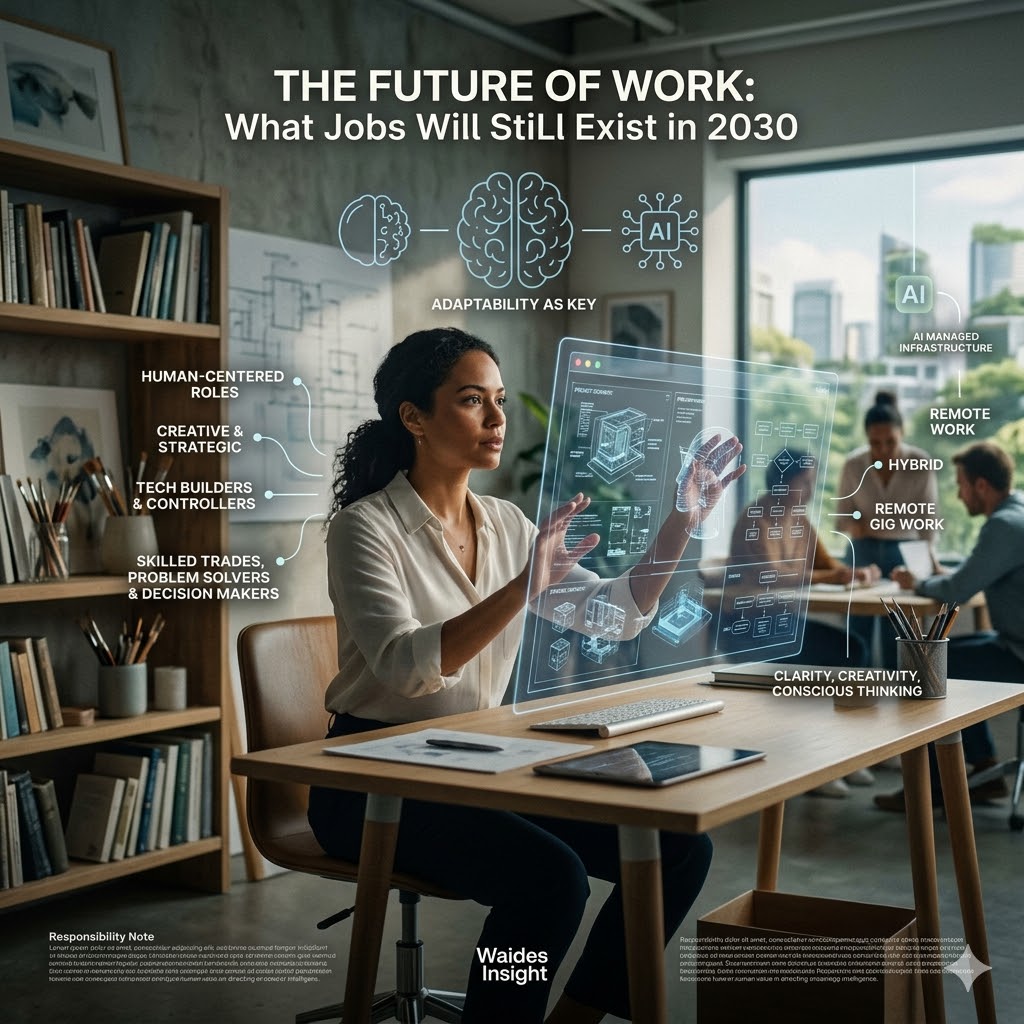
Work is not disappearing — it is evolving.
By 2030, the question will not be “Will there be jobs?”
It will be:
“What kind of jobs will still need humans?”
Because as machines become more capable, human value becomes more specific.
🤖 What AI Will Replace — And Why
Artificial intelligence is already transforming industries.
Companies like OpenAI and Google are building systems that can:
- Write
- Analyze data
- Automate repetitive tasks
By 2030, jobs most at risk include:
- Data entry
- Basic customer service
- Routine administrative roles
These jobs are not disappearing randomly —
They are being replaced because they follow predictable patterns.
🧠 Jobs That Will Still Exist — And Grow
The future belongs to work that requires:
- Judgment
- Creativity
- Human connection
- Complex decision-making
Here are the key categories that will remain strong:
1. Human-Centered Jobs
Jobs that require emotional intelligence will be difficult to replace.
- Doctors and nurses
- Therapists and counselors
- Teachers and mentors
Even with advanced technology, people will still need human understanding.
2. Creative and Strategic Roles
AI can generate — but humans still direct and define meaning.
- Designers
- Content creators
- Brand strategists
These roles will evolve, not disappear.
Humans will move from creating everything → to guiding intelligent systems
3. Technology Builders and Controllers
As AI grows, so does the need for people who build and manage it.
- Software engineers
- AI specialists
- Cybersecurity experts
Companies like Microsoft will continue to rely on skilled humans to maintain and expand systems.
4. Skilled Trade and Physical Jobs
Not all jobs can be digitized.
- Electricians
- Mechanics
- Construction workers
These roles require physical presence and adaptability — something machines still struggle with.
5. Problem Solvers and Decision Makers
Leadership will become even more important.
- Entrepreneurs
- Executives
- Policy makers
Because while machines provide data, humans still define:
Direction, ethics, and purpose
🌍 A Shift in How Work Is Done
By 2030, work itself will change:
- Remote and hybrid work will become normal
- Freelance and gig work will expand
- One person may have multiple income streams
The traditional idea of “one job for life” will fade.
⚖️ The Challenge: Displacement vs Opportunity
The transition will not be smooth.
- Some workers will lose jobs
- Others will need to reskill quickly
- Inequality may increase during the shift
Countries that invest in education and digital skills will adapt faster.
🧠 Konsmik Intelligence Analysis
according to KI analysis, the future of work is not about job loss — it is about job transformation.
Key signals show:
- Automation will remove routine, not purpose
- Human value will concentrate in fewer, higher-skill roles
- Adaptability will become the most important career asset
The biggest opportunity:
Humans working with AI, not against it
The biggest risk:
Systems changing faster than people can adapt
🌌 Konsmik Reality
From the lens of Konsmik Reality, work has always evolved with tools.
Historically:
- Machines replaced manual labor
- Computers replaced repetitive thinking
- Now AI is replacing predictable intelligence
But each shift created new roles.
By 2030:
Work will not be defined by what you do —
But by what you can uniquely contribute
Forecast:
The future workforce will divide into:
- Those who adapt and evolve
- Those who remain tied to outdated systems
🌿 Waides Insight
The future of work is not about competing with machines —
It is about becoming more human where machines cannot.
Because in 2030, the most valuable skills will not be:
- Speed
- Repetition
- Routine
They will be:
Clarity, creativity, and conscious thinking
Responsibility Note:
This analysis is intended to provide insight into future labor trends. Actual outcomes will depend on technological advancements, education systems, and global economic conditions.







Leave a Reply