

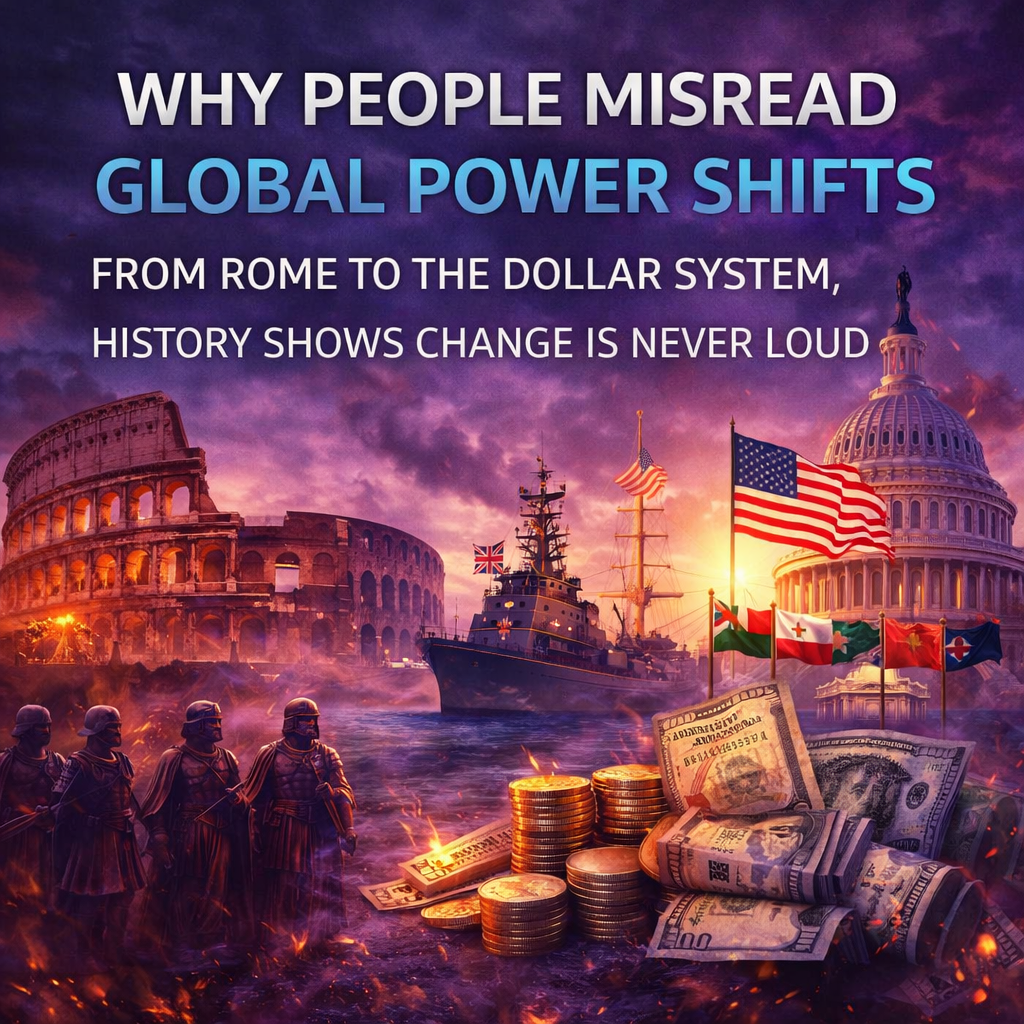
Waides Feed
A recent reaction to WaidesNiuz raised a familiar question: “If BRICS is rising, why are countries still under pressure?” It is a fair question on the surface — but it reveals a deeper misunderstanding of how power actually shifts in the real world.
Most people expect power transitions to look dramatic, obvious, and immediate. They imagine a moment where one system collapses and another replaces it overnight. But history shows something very different. Real power shifts are slow, uneven, and often hidden beneath visible instability.
Today’s global environment — war, energy disruption, rising costs — creates the illusion that strength must look stable at all times. But in reality, even rising systems face pressure while they are building influence. Short-term difficulty does not cancel long-term positioning.
This is the gap most people miss. They are watching events. The real story is in the structure beneath those events.
“Power does not disappear loudly — it redistributes quietly before the world notices.”
WHY IT MATTERS / PUBLIC CONTEXT
Global power is not shifting in headlines — it is shifting in systems.
If you only follow events, you will always misunderstand the direction of the world.
For everyday people, this matters because it shapes:
- Currency stability
- Cost of living
- Trade relationships
- Economic opportunity
Global Positioning
Opportunity: Emerging economies building alternative trade systems
Risk: Misreading signals and making wrong economic decisions
Shift: Movement from a single-dominant system toward a multi-polar structure
HISTORICALLY…
History has never shown a clean or instant transfer of power.
- The fall of the Roman Empire did not happen overnight. It took centuries of internal strain, economic pressure, and gradual loss of control before the world recognized its decline.
- The transition from the British Empire to the United States as the dominant global power did not occur in a single moment. Even after World War I, Britain still appeared influential, yet the financial and industrial power had already begun shifting toward America.
- The creation of the Bretton Woods System marked the formal rise of the US dollar — but that dominance was built gradually through trade, military influence, and financial institutions over decades.
In every case, the pattern is the same:
Power weakens quietly.
New systems grow quietly.
Recognition comes last.
KI ANALYSIS
According to KI analysis, the misunderstanding seen in the reaction is rooted in how humans interpret complexity.
Driving Forces Behind Misinterpretation:
Focus on visible events rather than underlying systems
Expectation of instant results in a slow-moving process
Confusion between short-term pressure and long-term positioning
Emotional reaction to current hardship
Power Mapping:
Beneficiaries:
Nations building alternative trade systems
Strategic blocs like BRICS expanding influence
Energy and resource-rich economies
Vulnerable:
Populations relying on outdated assumptions
Economies heavily dependent on a single system
Observers reacting instead of analyzing
Opportunities:
Understanding early-stage global shifts
Positioning ahead of structural change
Adapting to multi-polar economic systems
Risks:
Misreading direction and making poor financial decisions
Overreacting to short-term instability
Ignoring long-term global trends
FOR KONSMIK CIVILIZATION
In a Konsmik Civilization, power transitions are not left to chaos or misinterpretation. They are mapped, understood, and managed through intelligent systems.
Signals are tracked across economic, social, and geopolitical layers. Instead of reacting to events, the system anticipates structural change and prepares accordingly.
There is no confusion between pressure and weakness, because data and insight provide clarity. The population understands not just what is happening, but why it is happening.
The result is awareness instead of reaction.
SOLUTION LAYER (KSI)
Micro (Individuals):
Learn to distinguish between events and systems
Avoid reacting emotionally to headlines
Study long-term patterns, not short-term noise
Meso (Institutions):
Educate populations on economic systems
Build adaptive strategies for global shifts
Reduce dependency on single economic structures
Macro (System Level):
Encourage multi-polar economic cooperation
Strengthen resilience across global systems
Improve transparency in global financial structures
KONSMIK REALITY
Short-term (1–2 years):
This is already unfolding. Confusion and disagreement will increase as systems shift beneath visible instability.
Medium-term (3–5 years):
Signals suggest clearer formation of multi-polar economic blocs and reduced dominance of a single system.
Long-term (2030+):
Global systems evolve into distributed power structures, where influence is shared rather than centralized.
KI Confidence
Level: High
Range: 82–88%
Justification: Strong historical alignment, current geopolitical signals, and economic restructuring patterns
Closing Impact
The biggest mistake is not misunderstanding BRICS, the dollar, or global power.
The biggest mistake is expecting change to look obvious.
Because by the time it becomes obvious…
it has already happened.
Reflection Question
If history shows that power always shifts quietly…
what signs might we be ignoring today that will define tomorrow?








Leave a Reply