

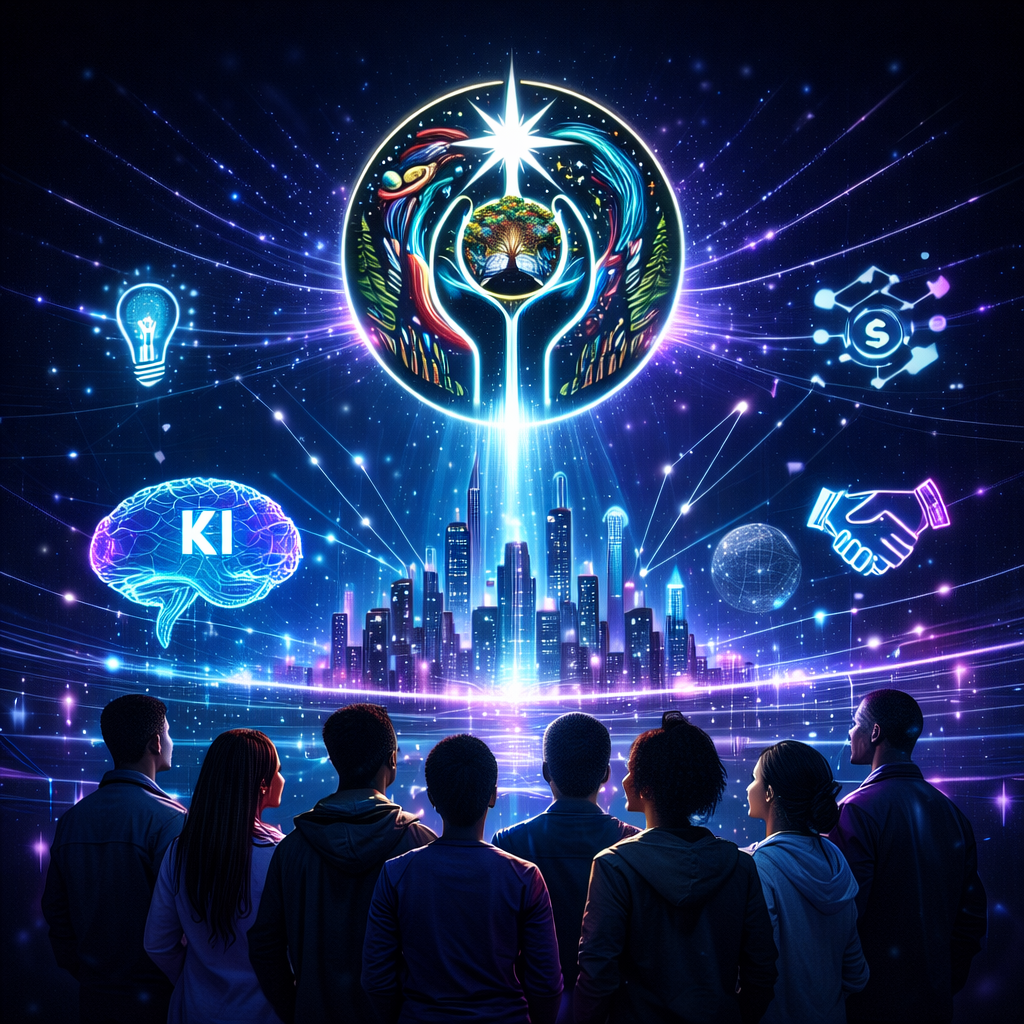
What if the future of humanity is not defined by countries… but by the systems people choose to belong to?
🧠 Waides Feed
Across the world, something quiet is unfolding.
It is not a protest.
It is not a revolution.
It is not even being announced loudly.
But it is happening.
People are beginning to detach — not physically, but mentally — from the systems they were born into. Nations still exist, borders still stand, but identity is shifting beyond them.
The question is no longer just “Where are you from?”
It is becoming “What do you belong to?”
This is where Konsmia enters the conversation.
Defined as The Trybe of the Future, Konsmia is not a country, not a government, and not a replacement for existing systems. It is a new layer — a civilizational identity built on shared purpose, growth, and collective progress.
As we will explore in our deeper breakdown of emerging digital civilizations, humanity is entering a phase where belonging is no longer inherited alone. It is chosen and built.
The future will not be shaped only by geography…
but by alignment.
💡 Why It Matters / Public Context
The world is moving from identity by birth… to identity by purpose.
Those who understand this shift early will position themselves inside the future — not outside it.
For individuals, this means new opportunities for growth and belonging. For societies, it signals a transformation in how people organize, cooperate, and build value.
📘 What is The Trybe of the Future (Konsmia)?
Konsmia is a civilizational system built on:
- Shared identity beyond borders
- Skill-based contribution and growth
- Collective ownership and development
- Unity without erasing cultural roots
It does not replace nations.
It exists above them as a unifying layer.
In simple terms:
👉 Konsmia is a system where people connect not by location…
but by purpose.
🌐 Real Examples / Current Use
- Rise of digital communities replacing traditional structures
- Global collaboration without physical borders
- Growth of skill-based economies (freelance, creator systems, digital work)
- Increasing desire for identity beyond tribe, race, or nationality
These are early signals of what Konsmia represents — a system that integrates these elements into one unified structure.
As we will explore in our analysis of future economic systems, participation is replacing location as the foundation of value.
⚙️ How It Works / Why It Matters
Konsmia operates on three core layers:
- Identity Layer
- People align based on purpose and values
- Economic Layer
- Value is created through skills, contribution, and collaboration
- System Layer
- Technology enables connection, coordination, and growth
Why this matters:
👉 It removes traditional barriers to participation
👉 It creates a system where anyone can contribute and grow
🕰️ Historical Context
Human organization has evolved through stages:
- Tribes (shared survival)
- Nations (shared governance)
- Globalization (shared markets)
Now, a new phase is emerging:
👉 Civilizations based on shared purpose
Just as the internet changed communication, this shift is changing identity itself.
🧬 KI Insight
According to KI analysis, Konsmia represents an early-stage model of a new civilizational structure where identity, economy, and participation are integrated into one system.
The pattern is clear:
👉 When traditional systems fail to meet evolving human needs, new systems emerge
This transition is driven by:
- Disconnection from existing structures
- Desire for ownership and contribution
- Technological ability to build new networks
From the perspective of Konsmik Civilization, this is not just an idea — it is a necessary evolution.
Opportunities:
- Creation of a unified global identity beyond division
- Empowerment of individuals through skill-based systems
- Reduction of poverty through collective economic structures
- New models of governance and collaboration
Risks:
- Misunderstanding or resistance from traditional systems
- Fragmentation if not guided properly
- Inequality in access to digital systems
- Misuse of decentralized structures
In Konsmik Civilization, systems are designed to align growth with purpose — ensuring that development benefits all participants.
🌍 For Konsmik Civilization
In Konsmik Civilization:
- Identity is chosen, not imposed
- Value is created through contribution, not position
- Systems are built for collective growth
System flow:
- Join through alignment
- Contribute through skill
- Grow through shared value
Outcome:
A system where humanity operates as a connected, evolving civilization.
🛠️ Solution Layer
Micro (Individual):
- Shift mindset from location-based identity to purpose-based identity
- Develop skills that contribute to collective systems
Meso (Community):
- Build networks based on shared goals
- Encourage collaboration across borders
Macro (System):
- Develop platforms that support decentralized participation
- Integrate economy, identity, and technology
- Promote inclusive growth structures
🌌 Konsmik Reality
Humanity has always searched for belonging.
But now, for the first time,
it can build it intentionally.
The Trybe of the Future is not a place.
It is a system.
And systems define reality.
🔮 Forecast
Short-Term (1–2 years):
- Growth of digital communities and identity networks
- Increased awareness of alternative systems like Konsmia
Medium-Term (3–5 years):
- Structured digital civilizations begin to emerge
- Integration of economic and identity systems
Long-Term (5–10 years):
- New civilizational layers coexist with nations
- Identity becomes multi-layered and purpose-driven
❓ FAQ
What is Konsmia?
A civilizational system built on shared purpose, identity, and economic participation.
Is Konsmia replacing countries?
No, it exists alongside them as a higher layer of identity.
Who can join Konsmia?
Anyone aligned with its values and purpose.
Why is this important?
Because it reflects the future direction of human organization.
🧠 Closing Impact
The future will not ask where you are from.
It will ask what you are part of.
🌍 Reflection Question
If identity is no longer fixed by birth,
what kind of system will you choose to belong to?







Leave a Reply