

Waides Feed
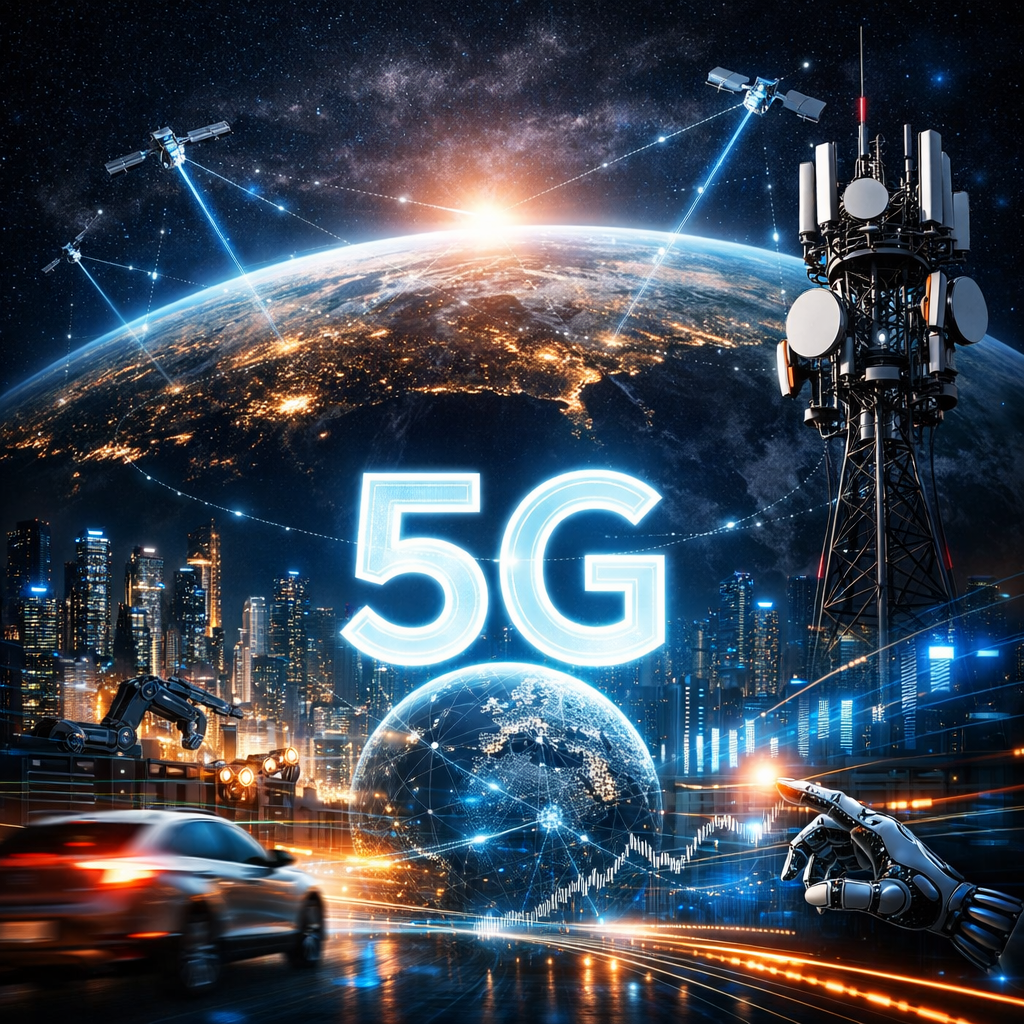
The rollout of 5G is not just an upgrade in internet speed. It is a restructuring of how reality itself is experienced in a connected world. What appears to the public as “faster downloads” is, beneath the surface, a strategic shift in global digital infrastructure, where speed becomes power, and latency becomes control.
Telecommunication giants, governments, and technology firms are not racing to deploy 5G simply for convenience. They are competing to control the next layer of digital dominance. From autonomous systems to real-time data economies, 5G enables a world where decisions are made instantly, machines communicate without delay, and human interaction merges seamlessly with digital environments.
The deeper signal here is not speed. It is synchronization. With near-zero latency, systems can now operate in real time across continents. Financial markets, healthcare systems, transportation networks, and even warfare are being redesigned around this capability. The faster the network, the tighter the control loop.
👉 Who benefits and why now?
Nations and corporations that control 5G infrastructure gain leverage over data flow, innovation ecosystems, and future economic dominance. The timing aligns with rising demand for AI, IoT, and immersive technologies that require ultra-fast, stable connectivity.
“Speed is no longer about convenience. It is about who controls the rhythm of reality.”
WHY IT MATTERS / PUBLIC CONTEXT
The world is not just getting faster. It is becoming real-time.
And those who cannot match that speed risk being left behind entirely.
For the average person, 5G means smoother streaming and quicker downloads. But in reality, it is reshaping how work, communication, and opportunity function.
Global Positioning: Africa & Emerging Markets
In regions like Africa, including countries such as Nigeria, 5G presents both a leap forward and a widening gap.
- Opportunity: Leapfrogging outdated infrastructure into smart cities, digital economies, and remote services
- Risk: Unequal access could deepen digital inequality between urban and rural populations
👉 What changes for the average person?
Access to opportunities will increasingly depend on connectivity quality, not just education or location.
HISTORICALLY…
Every major leap in communication technology has reshaped power structures.
- The telegraph compressed distance
- The internet democratized information
- 4G enabled the mobile economy
Now, 5G is doing something different. It is not just connecting people. It is connecting systems in real time.
History shows that those who adopt infrastructure early gain long-term advantages. The same pattern is repeating, but at a faster and more complex scale.
KI ANALYSIS
According to KI analysis…
5G is a foundational layer for the next phase of global systems evolution. Its true impact lies in enabling three critical transformations:
1. System Acceleration
Industries move from delayed response to real-time execution:
- Autonomous vehicles reacting instantly
- Smart factories optimizing production live
- Financial systems executing trades in milliseconds
2. Data Power Consolidation
Control over data transmission equals control over:
- AI training ecosystems
- National security intelligence
- Economic decision-making flows
3. Behavioral Shift
Humans begin to expect:
- Instant results
- Continuous connectivity
- Seamless digital-physical interaction
Power Mapping
- Telecom giants → infrastructure control
- Governments → regulatory leverage
- Tech companies → data monetization
Opportunities
- Smart cities and infrastructure
- Remote healthcare and education
- New digital economies and job creation
Risks
- Surveillance expansion
- Infrastructure dependency
- Cybersecurity vulnerabilities
👉 Why timing matters:
5G arrives exactly as AI, IoT, and automation demand real-time data environments. Without it, these systems cannot scale.
FOR KONSMIK CIVILIZATION
In today’s world, connectivity is uneven, profit-driven, and often exclusionary.
In a Konsmik Civilization system, connectivity is treated as a universal utility, not a commercial advantage.
Step by step:
- Infrastructure is distributed, not centralized
- Access is balanced across all regions equally
- Data flow is ethically governed, not exploited
Outcome difference:
- No digital divide
- Equal participation in the global economy
- Technology serves humanity, not hierarchy
SOLUTION LAYER (KSI)
Micro (Individuals)
- Develop digital skills aligned with real-time systems
- Leverage high-speed connectivity for remote opportunities
- Stay aware of data privacy and usage
Meso (Institutions)
- Invest in inclusive infrastructure
- Build systems optimized for low-latency environments
- Train workforce for emerging digital ecosystems
Macro (System Level)
- Enforce fair access policies
- Regulate data control and privacy
- Encourage decentralized network models
KONSMIK REALITY
Short-term (1–2 years)
This is already unfolding…
Urban centers globally will experience rapid 5G expansion, enabling new services and business models.
Medium-term (3–5 years)
Signals suggest…
Entire industries will restructure around real-time capabilities, with automation and AI deeply integrated.
Long-term (2030+)
Early indicators show…
The world transitions into a fully synchronized digital ecosystem, where physical and digital realities merge seamlessly.
KI Confidence
Confidence Level: High
Confidence (% Range): 78–85%
Justification:
Strong alignment across telecom investments, government policies, and technological demand indicates sustained and accelerating 5G adoption globally.
Closing Impact
5G is not just making the internet faster.
It is redefining who can participate in the future.
The real divide will not be between those who have internet and those who do not.
It will be between those who live in real time… and those who are always catching up.
Reflection Question
If speed becomes the foundation of power,
👉 Who controls your connection and what does that mean for your future?









Leave a Reply