

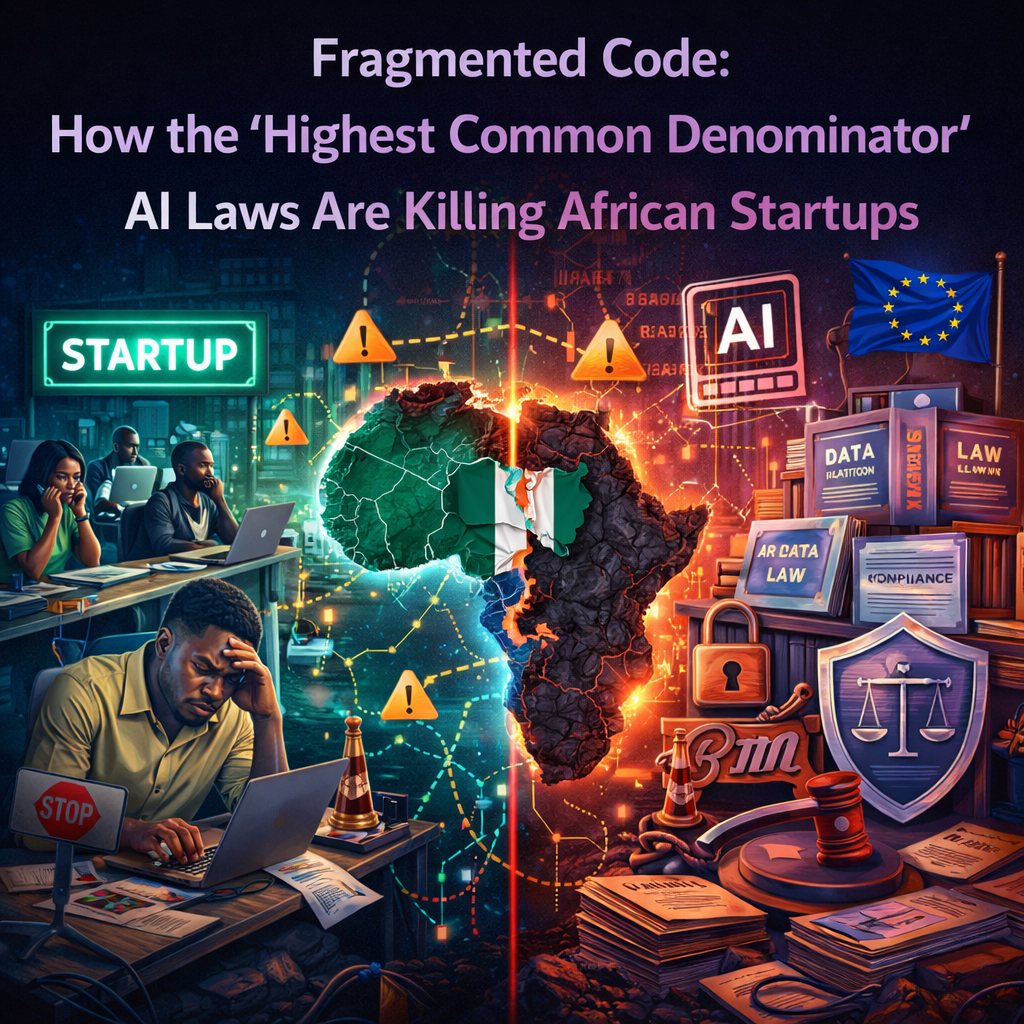
What if the rules meant to protect innovation are quietly preventing it from ever starting
🧠 Waides Feed
Across the global technology landscape, artificial intelligence is advancing at an unprecedented pace. Governments are responding with new laws designed to ensure safety, accountability, and ethical use. On the surface, this seems necessary.
But beneath that layer, a quieter reality is emerging — one that is reshaping innovation across Africa.
Many African countries are beginning to adopt regulatory frameworks inspired by global standards. These frameworks are often designed for mature ecosystems with strong infrastructure, established companies, and large-scale resources. When applied directly to emerging markets, however, they create a different outcome.
For startups, the impact is immediate.
As we will explore in our deeper breakdown of global AI governance systems, regulation does not just define safety — it defines who is able to participate in the system.
This is where the concept of the “highest common denominator” becomes critical.
Instead of tailoring policies to local realities, the strictest global standards are being applied across diverse environments. The result is a fragmented regulatory landscape where startups must navigate complex compliance requirements before they even have the chance to grow.
This is not just a policy issue.
It is a structural constraint.
The future of innovation will not depend only on ideas…
but on whether systems allow those ideas to emerge.
💡 Why It Matters / Public Context
Innovation cannot grow where entry barriers are too high.
If startups struggle to begin, entire ecosystems struggle to exist.
For African economies, this means fewer local solutions, reduced competitiveness, and increased dependence on foreign technologies.
📘 What is the “Highest Common Denominator” AI Law Problem?
The “highest common denominator” approach refers to applying the strictest global regulatory standards universally, regardless of local context.
This includes:
- Heavy compliance requirements
- Strict data protection rules
- Complex approval processes
While these rules are effective in advanced ecosystems, they can become barriers in emerging ones.
In simple terms:
👉 Rules designed for large systems are being applied to small, growing ones.
🌐 Real Examples / Current Use
- Startups needing to meet high compliance standards before scaling
- Multiple countries with differing AI and data regulations
- Increased cost of legal and operational compliance
- Slower product development due to regulatory constraints
This reflects a broader pattern seen in global systems, where alignment with external standards creates internal pressure.
As we will explore in our analysis of emerging digital economies, systems that prioritize compliance over growth often struggle to innovate.
⚙️ How It Works / Why It Matters
AI development requires:
- Experimentation
- Iteration
- Rapid deployment
Regulation introduces:
- Approval layers
- Compliance costs
- Operational delays
When these combine:
👉 Innovation slows down
Why this matters:
👉 Startups operate with limited resources
👉 Compliance becomes a barrier, not a safeguard
🕰️ Historical Context
Every major innovation cycle has followed a similar pattern:
- Early stages require flexibility
- Growth phases introduce regulation
- Mature systems balance both
When regulation comes too early or too rigidly:
👉 It suppresses the very ecosystem it aims to guide
This pattern has been seen across industries, from finance to telecommunications.
🧬 KI Insight
According to KI analysis, the challenge facing African startups is not regulation itself, but the misalignment between regulatory design and ecosystem maturity.
The system dynamic is clear:
👉 Large companies absorb regulation
👉 Small innovators struggle under it
This creates an uneven playing field.
From the perspective of Konsmik Civilization, this reflects a deeper principle:
👉 Systems must evolve with the entities they govern
Opportunities:
- Development of startup-friendly AI policies
- Creation of regulatory sandboxes for experimentation
- Harmonization of regional frameworks
- Positioning Africa as a flexible innovation hub
Risks:
- Suppression of early-stage startups
- Reduced innovation output
- Increased reliance on foreign AI systems
- Fragmentation of markets across countries
In Konsmik Civilization, regulation would be adaptive — scaling with growth, rather than restricting it at inception.
🌍 For Konsmik Civilization
In Konsmik Civilization:
- Regulation evolves alongside innovation
- Early-stage systems are protected, not constrained
- Growth is enabled before control is enforced
System flow:
- Allow innovation to emerge
- Guide growth responsibly
- Introduce regulation progressively
Outcome:
A balanced ecosystem where safety and innovation coexist.
🛠️ Solution Layer
Micro (Individual / Founder):
- Build awareness of regulatory environments
- Design flexible, compliant-ready systems
Meso (Ecosystem):
- Encourage collaboration between startups and regulators
- Share best practices across regions
Macro (Government):
- Develop adaptive regulatory frameworks
- Introduce innovation sandboxes
- Harmonize policies across African markets
- Reduce early-stage compliance burden
🌌 Konsmik Reality
Regulation is not the enemy of innovation.
But misaligned regulation is.
When systems are built to control before they understand,
they limit what could have been created.
🔮 Forecast
Short-Term (1–2 years):
- Increased compliance pressure on startups
- Slower pace of AI innovation
Medium-Term (3–5 years):
- Policy adjustments toward more flexible frameworks
- Emergence of innovation-friendly environments
Long-Term (5–10 years):
- Regions that balance regulation and innovation lead
- Others fall into dependency on external systems
❓ FAQ
Why are AI laws affecting startups in Africa?
Because they introduce high compliance requirements early in development.
What is fragmented regulation?
Different rules across countries, making it harder to scale.
Are AI laws bad?
No, but they must be aligned with the stage of ecosystem growth.
Can this be fixed?
Yes, through adaptive and startup-friendly policy design.
🧠 Closing Impact
The future of Africa’s AI ecosystem will not be decided by talent alone.
It will be decided by the systems that either enable it…
or quietly limit it.
🌍 Reflection Question
If innovation must ask for permission before it exists,
how many ideas will never be born?












Leave a Reply