

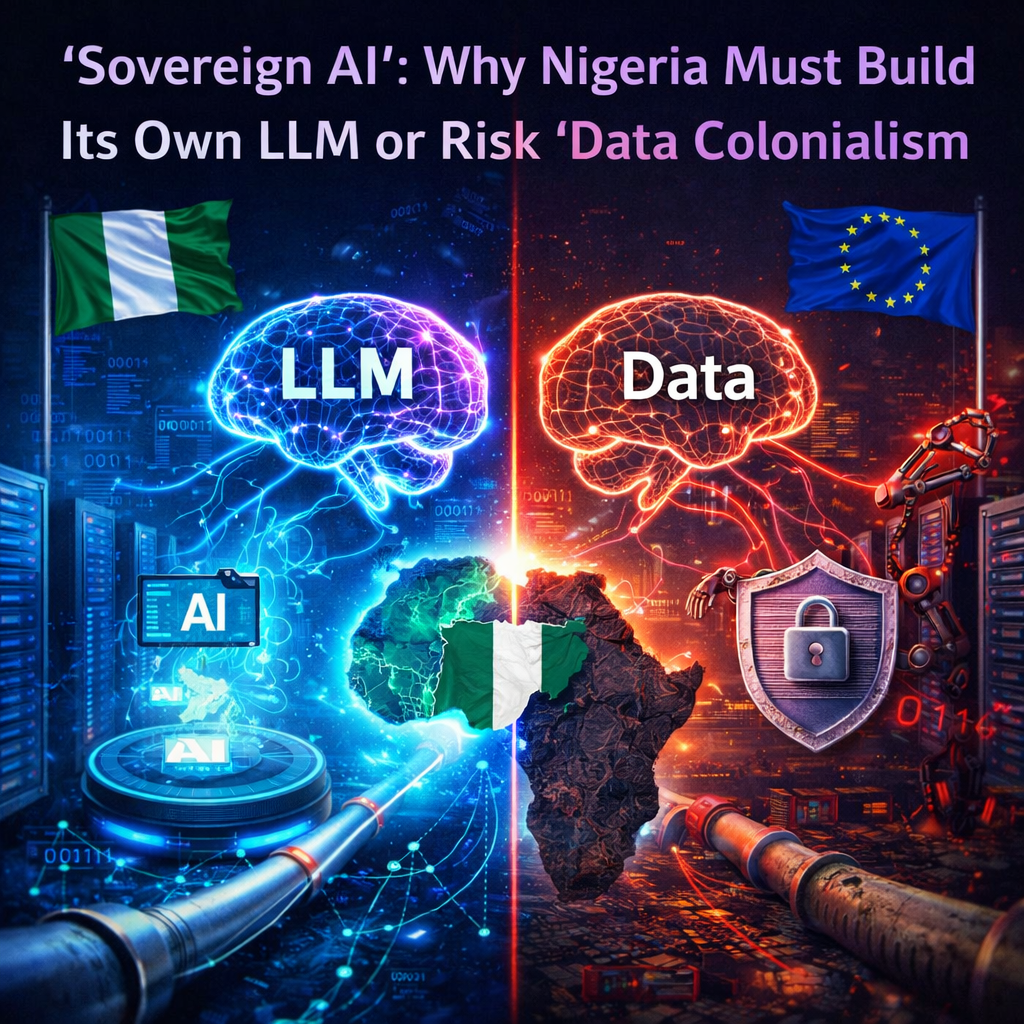
What happens when a nation produces data… but does not control the intelligence built from it?
🧠 Waides Feed
A new form of power is quietly emerging in the global system — not based on land, oil, or currency, but on intelligence itself.
Artificial intelligence, particularly large language models, is reshaping how people learn, think, and make decisions. But behind this transformation lies a deeper question: Who controls the intelligence systems shaping the world?
Today, most advanced AI systems are developed and controlled by a handful of global tech powers. Countries like Nigeria are active users of these systems — but not their creators.
This creates an invisible imbalance.
As we will explore in our deeper breakdown of global AI power structures, data is no longer just information. It is a resource that fuels intelligence systems. And when that data is processed elsewhere, the value it generates also leaves.
This is where the concept of “Sovereign AI” becomes critical.
The future will not belong to those who use intelligence…
but to those who build it.
💡 Why It Matters / Public Context
AI is not just a tool — it is becoming the system that shapes knowledge itself.
If Nigeria does not build its own AI, it risks becoming a data source instead of a value creator.
For everyday people, this means the information they rely on may not fully reflect their realities, cultures, or priorities.
📘 What is Sovereign AI?
Sovereign AI refers to a country’s ability to develop and control its own artificial intelligence systems, including large language models (LLMs).
This involves:
- Owning the data used to train AI
- Building the infrastructure (compute, storage, research)
- Designing systems aligned with local needs and realities
In simple terms:
👉 Sovereign AI means owning your intelligence system, not renting it
🌐 Real Examples / Current Use
- Global tech companies building AI models trained on vast datasets
- Countries beginning to invest in national AI strategies
- African data being used in global AI systems without proportional local benefit
- Increasing reliance on foreign AI tools for education, business, and communication
This reflects a broader global shift where digital systems are becoming central to economic and societal control.
As we will explore in our analysis of emerging digital economies, those who control data systems shape future markets.
⚙️ How It Works / Why It Matters
AI systems operate on three core components:
- Data
- Compute infrastructure
- Algorithms
Nigeria contributes heavily to the first — data — but has limited control over the others.
Why this matters:
👉 Data alone does not create power
👉 Control over processing and application does
When AI is built externally:
- Local data fuels foreign intelligence
- Outputs may not reflect local context
- Decision-making frameworks become externally influenced
🕰️ Historical Context
This pattern is not new.
History has shown that:
- Resource extraction without local control leads to dependency
- Industrial revolutions reward those who build systems, not those who supply raw materials
In the digital age:
👉 Data has replaced raw materials
👉 AI has replaced industrial machinery
This is the new frontier.
🧬 KI Insight
According to KI analysis, the rise of AI represents a shift from economic control to cognitive control — where influence is exerted through knowledge systems rather than physical resources.
The core dynamic:
👉 Data → Intelligence → Influence
Nigeria currently participates at the data level but risks missing out on the intelligence and influence layers.
From the perspective of Konsmik Civilization, this highlights a fundamental truth:
👉 A system that does not control its intelligence cannot control its future
Opportunities:
- Development of local LLMs tailored to Nigerian languages and realities
- Creation of a domestic AI ecosystem
- Economic growth through digital innovation
- Preservation of cultural and intellectual identity
Risks:
- Data extraction without local value capture
- Cultural misrepresentation in global AI systems
- Long-term dependency on foreign technology
- Loss of control over information systems
In Konsmik Civilization, intelligence systems would be locally grounded but globally connected — ensuring that knowledge reflects both identity and innovation.
🌍 For Konsmik Civilization
In Konsmik Civilization:
- AI systems are built within the ecosystem
- Data remains within controlled networks
- Intelligence reflects local realities while connecting globally
System flow:
- Collect data
- Process locally
- Deploy intelligence systems
Outcome:
A system where knowledge creates sovereignty, not dependency.
🛠️ Solution Layer
Micro (Individual):
- Build awareness of how AI shapes information and perception
Meso (Community / Industry):
- Support local AI startups and innovation ecosystems
- Encourage research and development in AI
Macro (Government):
- Invest in AI infrastructure and data centers
- Develop national AI strategy
- Fund research institutions and talent development
- Create policies for data protection and sovereignty
🌌 Konsmik Reality
The future will not be controlled by those who hold resources.
It will be controlled by those who shape understanding.
AI is not just technology.
It is the architecture of thought.
And if that architecture is built elsewhere,
so is influence.
🔮 Forecast
Short-Term (1–2 years):
- Continued reliance on foreign AI systems
- Growing awareness of data sovereignty issues
Medium-Term (3–5 years):
- Emergence of local AI initiatives
- Increased investment in digital infrastructure
Long-Term (5–10 years):
- Nations divide into AI producers and AI consumers
- Sovereign AI becomes a defining factor of national power
❓ FAQ
What is data colonialism?
It is the extraction of data from a region without local control or benefit.
Does Nigeria have AI capabilities?
Yes, but large-scale model development is still limited.
Why is Sovereign AI important?
It ensures control over data, knowledge, and decision-making systems.
Can Nigeria build its own LLM?
Yes, with the right investment in infrastructure and talent.
🧠 Closing Impact
The question is no longer whether Nigeria will use AI.
It is whether Nigeria will own the intelligence shaping its future.
🌍 Reflection Question
If your data builds intelligence somewhere else,
who is really shaping your reality?







Leave a Reply