

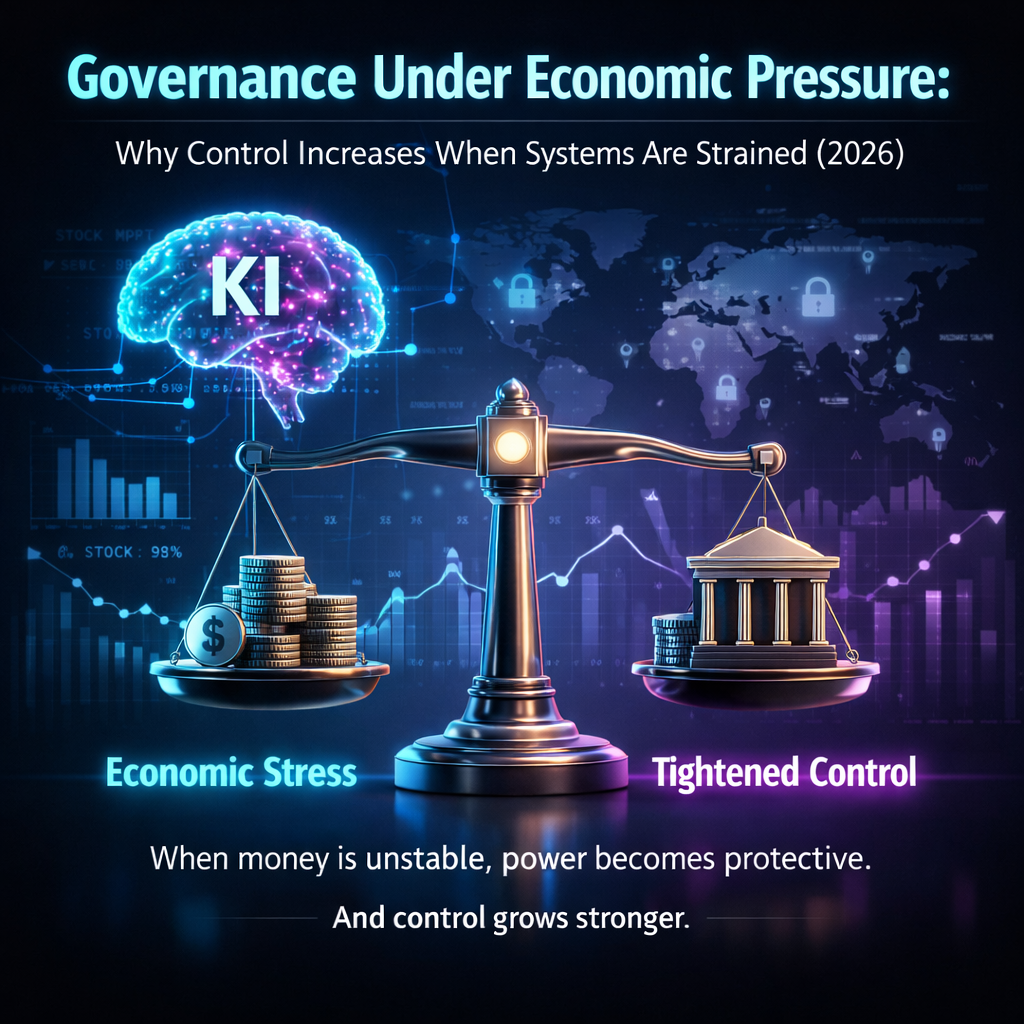
When economies struggle… why do governments become more controlling?
Waides Feed
Across the world, a quiet but consistent pattern is emerging. When economic pressure rises, governance does not weaken. It tightens. Systems do not collapse immediately. They respond by increasing control, stabilizing structures, and managing uncertainty through authority.
This is not accidental. Economic strain creates instability, and instability threatens the continuity of power. Governments, institutions, and leadership structures are designed to preserve order first, even before solving underlying problems. This is part of a broader shift shaping global power systems, where stability is often maintained through control rather than consensus.
As economic conditions become more difficult, decisions become more centralized. Policies become stricter. Oversight increases. This connects to the wider transformation we are seeing in global power shifts, where pressure forces systems to adapt, not disappear.
At the human level, this shift is often felt as reduced freedom, higher regulation, and increased economic tension. But at the system level, it is seen as necessary stabilization. The gap between these two realities is where most of the tension lives.
The future is not shaped only by economic growth, but by how systems behave when growth slows.
Why It Matters (Silver Platter)
When money becomes unstable, power becomes protective.
And when power becomes protective, control increases.
This affects freedom, opportunity, and how people experience everyday life.
What Is Governance Under Economic Pressure?
Governance under economic pressure refers to how governments respond when the economy is strained.
In simple terms:
👉 When the economy struggles, governments take stronger control to maintain stability.
Real Examples / Current Use
- Governments tightening financial policies to control inflation
- Increased regulation of markets and businesses
- Political pressure on opposition or dissenting voices
- Expansion of state influence over economic systems
- Strategic partnerships to stabilize national economies
This reflects a broader global pattern where economic stress reshapes governance structures and decision-making processes.
How It Works / Why It Matters
The system follows a predictable pattern:
- Economic pressure rises (inflation, unemployment, instability)
- Public tension increases
- Governments act to maintain order
- Control mechanisms expand
This is not always about oppression.
It is often about preventing breakdown.
This connects to how power and economic systems respond under stress, where control becomes a tool for stability.
Historically…
Throughout history, periods of economic stress have often led to stronger governance control.
- During financial crises, governments increase intervention
- During instability, authority becomes more centralized
- During uncertainty, systems prioritize order over flexibility
This pattern repeats because the core function of governance is survival of the system.
🧬 KI Insight
according to KI analysis, while governance structures justify increased control as necessary for stability, the real impact is experienced by citizens who face rising costs, limited economic flexibility, and reduced ability to influence decisions that shape their lives.
Opportunities:
- Short-term stabilization of economic systems
- Prevention of systemic collapse
- Ability to coordinate national response effectively
Risks:
- Reduced freedom and increased restriction
- Long-term imbalance between power and representation
- Growing disconnect between leadership and citizens
🌍 For Konsmik Civilization
A stronger system does not rely only on control.
It balances control with trust.
Step-by-step:
- Transparent governance systems
- Economic policies aligned with real human impact
- Shared decision-making where possible
Outcome:
👉 Stability that people can feel, not just systems can measure
🛠️ Solution Layer
Micro (Individuals):
- Stay informed about economic policies
- Adapt financially and mentally to changing conditions
Meso (Institutions):
- Improve communication and transparency
- Balance enforcement with public trust
Macro (Governments):
- Align control with fairness
- Ensure policies reduce pressure, not just manage it
🌌 Konsmik Reality
Control is not the beginning of collapse.
It is often the first response to pressure.
But if control replaces balance, the system may appear stable… while tension continues to grow beneath the surface.
🔮 Forecast
Short-Term (1–2 Years):
Increased regulation and policy tightening across multiple regions.
Medium-Term (3–5 Years):
Systems will either:
- Stabilize and adapt
- Or face rising public resistance
Long-Term (5–10 Years):
A shift toward more balanced governance models… or more controlled systems, depending on how pressure is managed.
❓ FAQ
What is governance under economic pressure?
It is how governments respond when the economy becomes unstable.
Why do governments increase control during economic crises?
To maintain stability and prevent system breakdown.
Is increased control always negative?
Not always. It can stabilize systems but may limit freedom.
What does this mean for people?
Higher regulation, economic pressure, and changes in daily life.
🧠 Closing Impact
When systems are under pressure, they reveal their true nature.
Not in how they grow…
But in how they hold control.
🌍 Reflection Question
Is control protecting stability… or quietly replacing balance?











Leave a Reply