

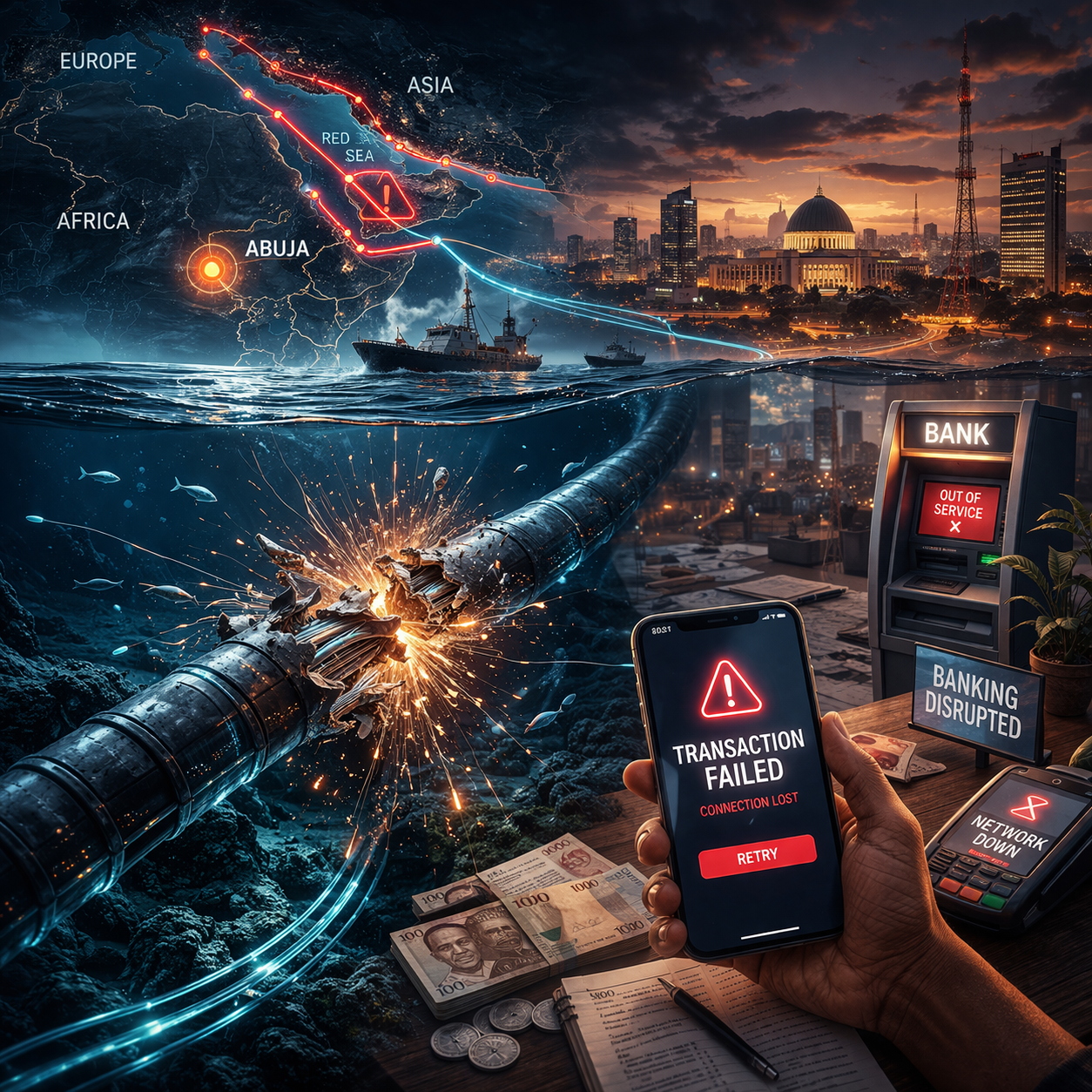
You wake up in Abuja. You try to transfer money. It fails. POS machines stop working. ATMs begin to run dry. Banks are open, but nothing is moving.
No attack in the city. No visible crisis.
But something far away has already reached you.
Deep under the sea, a cable is cut.
And suddenly, movement stops.
This is not a theory. This is how modern systems fail, quietly, instantly, and without warning.
Waides Feed
What most people call “the internet” is not in the air. It is not abstract. It is physical.
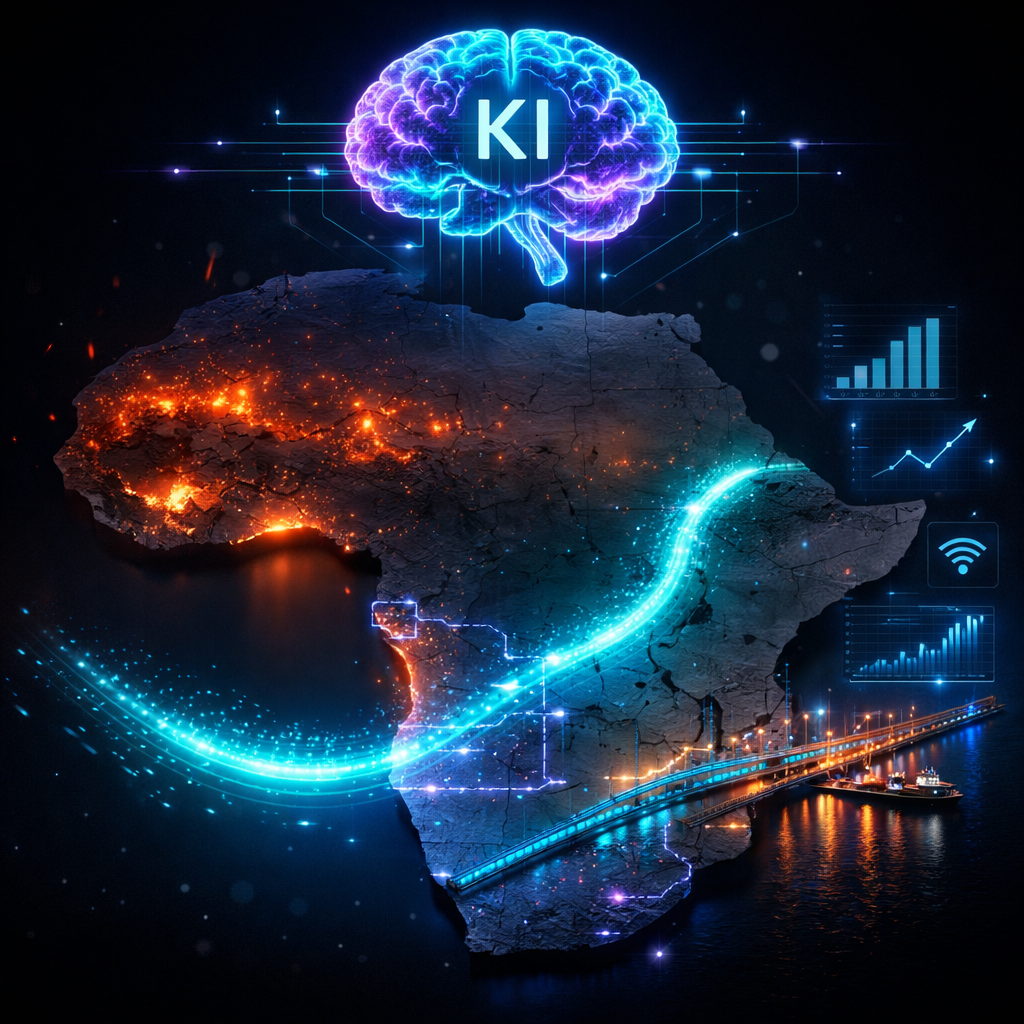
It runs through thousands of kilometers of cables laid across oceans. These cables carry almost all global data, including financial transactions, banking signals, and digital payments.
Nigeria, including Abuja, depends heavily on these connections. When you send money, use POS, or access your bank app, your data often travels far beyond the country before returning.
Now consider this.
A large portion of these global connections pass through the Red Sea, one of the most strategically sensitive and unstable regions in the world today.
If that route is disrupted, the effect is not local.
It spreads.
👉 “The most powerful systems are the ones you do not see, until they stop working.”
This connects to a deeper global shift where control is no longer about territory, but about infrastructure. The future is not built by innovation alone, but by those who control its direction.
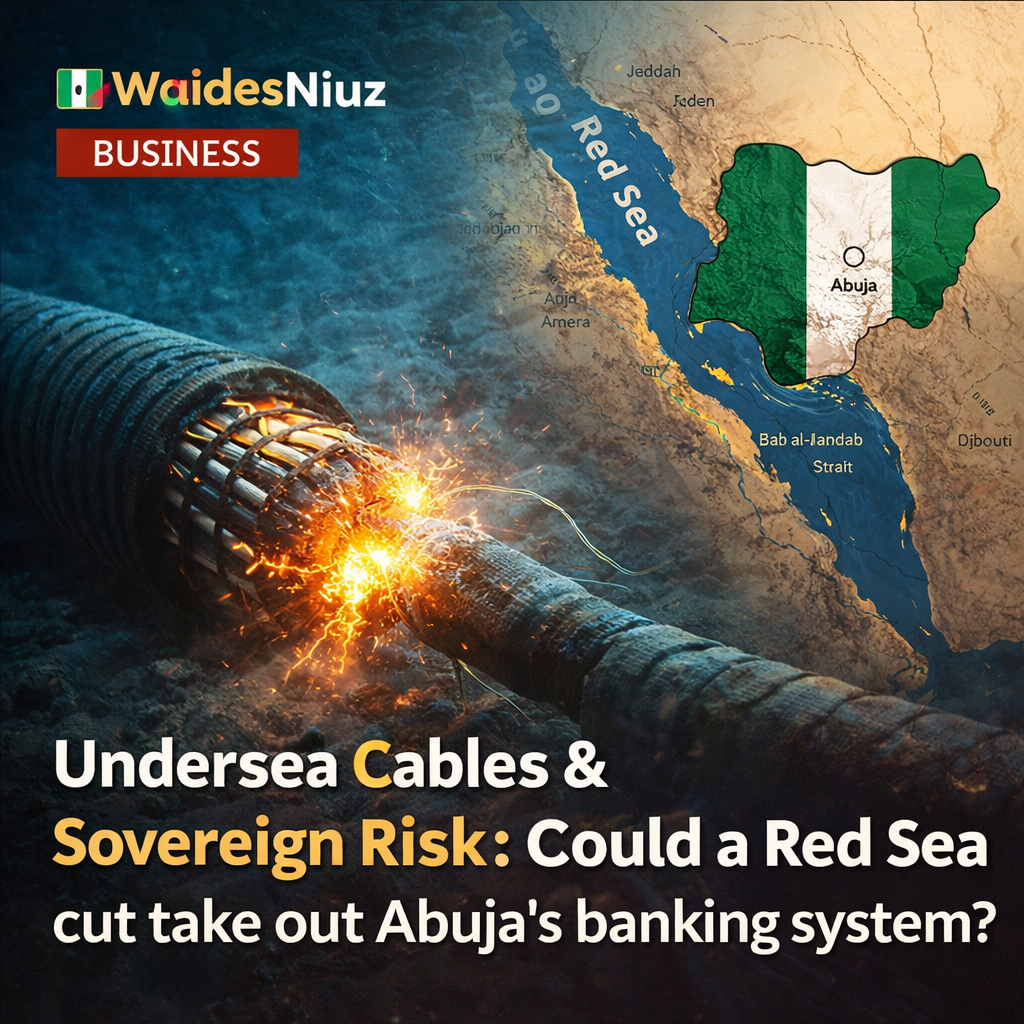
Why It Matters
Your money is not just in your bank. It is in motion across systems.
When connectivity breaks, transactions fail, payments delay, and trust begins to weaken.
👉 “A digital economy without connection is an economy on pause.”
👉 “The real risk is not losing money, it is losing access to it.”
The question is no longer if this matters, but whether you understand how exposed the system is.
What Are Undersea Cables
Undersea cables are long fiber optic lines laid across the ocean floor. They carry internet data between countries and continents.
They are responsible for:
- Bank transfers
- Online payments
- Financial messaging systems
- Cloud services
Almost everything digital depends on them.
Without these cables, modern banking cannot function properly.
Why You Can’t Ignore This
Nigeria is becoming more digital.
Cashless payments, mobile banking, POS systems, and fintech platforms are growing rapidly. This creates speed and convenience, but also dependency.
If a major cable route is disrupted:
- Transactions may stop
- Payments may delay
- Businesses may struggle
- Daily life may slow down
This is not just about technology.
It is about access to your own money.
👉 Those who understand systems early do not panic, they prepare.
Real World Signals
Verified Signals
- Over ninety percent of global internet traffic travels through undersea cables
- The Red Sea is one of the most critical global data corridors connecting Europe, Asia, and Africa
- Past cable damages have caused regional internet slowdowns and disruptions
Human Experience
- During network outages in Nigeria, people already experience failed transfers and delayed payments
- Businesses lose income when POS systems stop working
- Individuals struggle when banking apps become unreliable
Emerging Truth
This is a hidden vulnerability.
Modern economies are strong on the surface, but fragile underneath.
How It Works
When you make a bank transfer:
- Your request leaves your device
- It travels through local networks
- It connects to international systems
- It returns with confirmation
If any major route in this chain is disrupted, the system slows or stops.
Undersea cables are the highways of this system.
If the highway is cut, movement ends.
This is where power exists.
Historical Context
Infrastructure has always been a target.
In the past:
- Armies attacked roads and trade routes
- Nations fought over oil pipelines
Today:
- Data routes are the new trade routes
- Undersea cables are the new pipelines
The method has changed, but the logic is the same.
Control the route, control the system.
🧬 KI Analysis
According to KI analysis…
Causes
- Heavy global dependence on a few major cable routes
- Increasing geopolitical tension in strategic maritime zones
- Limited redundancy in African connectivity infrastructure
- Rapid digital adoption without equal resilience investment
- Low awareness of infrastructure risk
Human Impact
- Failed transactions during disruptions
- Business losses due to payment system downtime
- Reduced trust in banking systems
- Economic slowdowns during outages
In Konsmik Civilization terms, this is a shift from visible banking structures to invisible infrastructure dependency.
Opportunities
- Investment in alternative cable routes
- Development of local data centers and infrastructure
- Expansion of satellite backup systems
- Stronger fintech resilience frameworks
Risks
- Nationwide banking disruptions
- Economic instability
- Increased vulnerability to external shocks
- Unequal impact on smaller businesses and low income users
For Konsmik Civilization
A stronger system must not depend on a single pathway.
Future systems should be:
- Distributed
- Redundant
- Locally supported
Digital power must be balanced with resilience.
Access to money should not depend on a single global route.
Step by Step Action Path
Step 1, Awareness
Understand that your access to money depends on global infrastructure
Step 2, Positioning
Stay informed about how financial systems and networks operate
Step 3, Action
Maintain multiple payment options, including offline or cash alternatives
Step 4, Leverage
Position yourself in sectors building resilient infrastructure and systems
Konsmik Reality
Past
Power was controlled through physical assets like land and resources
Present
Power is controlled through digital systems and infrastructure
Future
Power will belong to those who control connection and access
👉 “Those who understand systems early will not just adapt, they will shape the future.”
Short Term
Temporary disruptions increase awareness
Medium Term
Investment in redundancy grows
Long Term
Infrastructure control becomes the core of economic power
FAQ
Can a cable cut really affect Nigeria’s banking system
Yes, because banking systems rely on global connectivity for transactions
Why is the Red Sea important
It is a major route for global data flow between continents
Does Nigeria have backup systems
There are some, but redundancy is still limited
What happens during a disruption
Transactions slow down or fail, affecting businesses and individuals
Closing Insights
The system you trust is not as invisible as you think.
It is just hidden.
And what is hidden is often where the greatest risk exists.
Reflection
- What happens when access to your money depends on systems you cannot see
- Are we building convenience, or creating silent vulnerability







Leave a Reply