

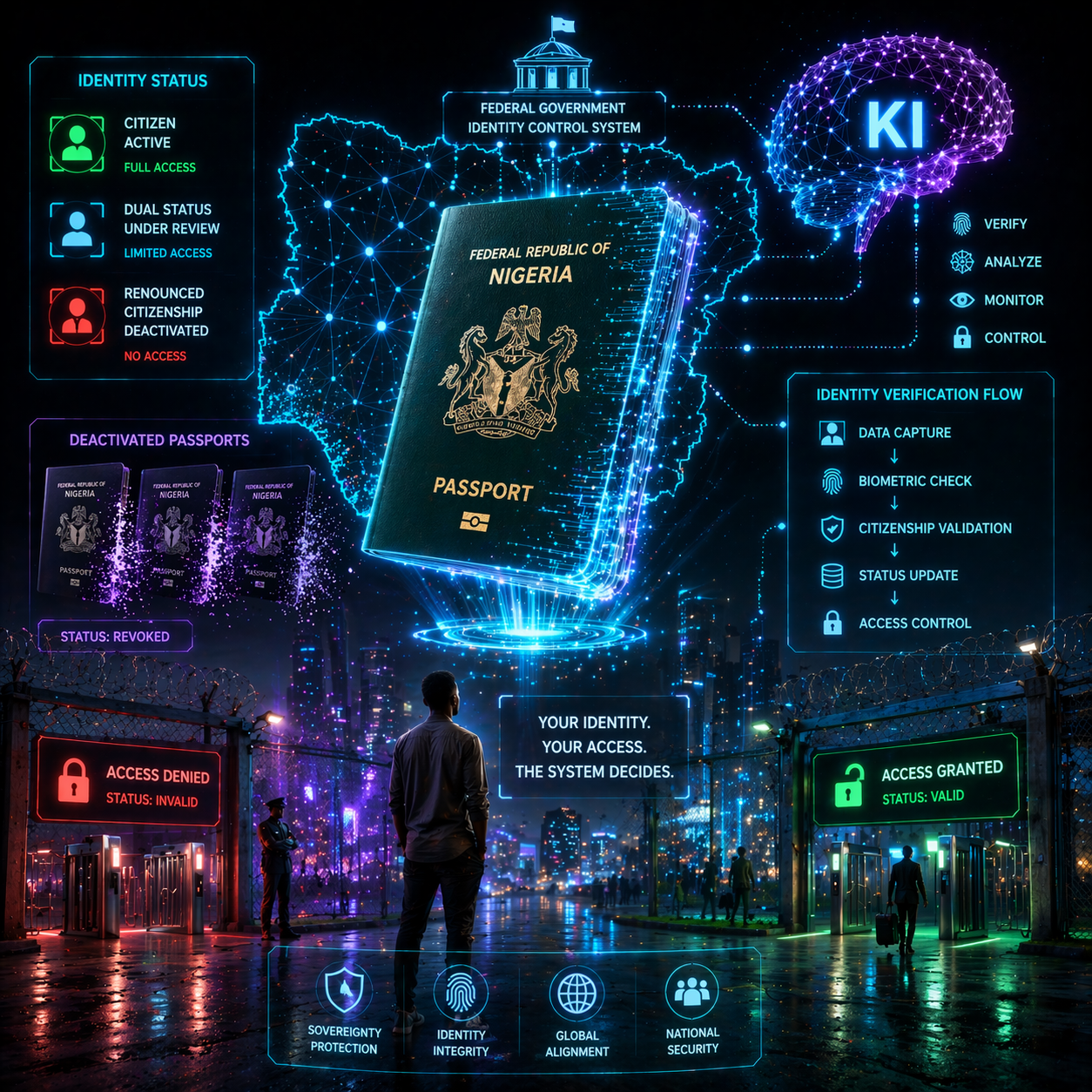
You may think your passport is just a travel document.
But what if it is something more?
What if it is a key, not just to movement, but to identity, access, and control?
Nigeria’s recent move to deactivate passports of individuals who have renounced their citizenship looks simple on the surface. But beneath it is a deeper shift.
This is not about documents.
This is about who belongs, and who decides.
Waides Feed
The directive to withdraw and deactivate passports of those who have formally renounced Nigerian citizenship signals a tightening of identity control under the authority of the state.
At the center of this system is the government, led by President , reinforcing a principle that is becoming more dominant globally:
👉 Identity must align with legal status
👉 Access must align with belonging
This connects to a broader transformation already unfolding across global systems, where citizenship is no longer passive. It is becoming structured, monitored, and enforced.
A passport is not just a document.
It is:
- A gateway to global mobility
- A marker of national identity
- A tool of geopolitical control
The deeper system is clear:
👉 When identity is controlled, movement is controlled
👉 When movement is controlled, power is controlled
The future is not just about borders. It is about the systems that define who can cross them.
Why It Matters / Public Context
This is not about passports. It is about access, identity, and national control.
For everyday Nigerians, it determines who retains rights, protection, and connection to the country, even after leaving it.
What Is Citizenship and Passport Control?
Citizenship is your legal identity within a country.
A passport is the physical proof that allows you to:
- Travel internationally
- Access consular protection
- Represent your country abroad
In simple terms:
👉 Citizenship gives you belonging
👉 A passport gives you movement
When one changes, the other must follow.
Why You Can’t Ignore This
This shift is not just about policy.
It is about where the next level of:
- Global mobility
- Identity security
- Access to opportunity
will be controlled.
If you understand how identity systems are evolving, you understand how the world will regulate movement in the future.
If you ignore it, you risk being affected by systems you do not fully understand.
“The future does not reward awareness, it rewards early positioning.”
🌍 Real-World Signals
- Governments worldwide are strengthening identity verification systems
- Institutions like highlight increasing global migration pressures
- Countries such as and are tightening immigration and citizenship policies
- Digital identity systems are becoming central to governance
This reflects a global pattern:
👉 Identity is becoming a regulated asset, not just a personal attribute
How It Works
The system behind this policy operates in four steps:
- Status Change
An individual formally renounces citizenship - System Update
Government records reflect the change - Access Withdrawal
Passport is deactivated to prevent misuse - Control Enforcement
Only valid citizens retain access to national identity systems
👉 This ensures alignment between identity and access
Historical Context
- In the past, identity systems were less strict and more fragmented
- Individuals could maintain access even after status changes
- This created loopholes and inconsistencies
Now, the system is evolving:
👉 From flexible identity
👉 To controlled and verified identity
🧠 KI Analysis
According to KI analysis, this shift represents a deeper restructuring of identity systems.
Causes:
- Rising global migration
- Need for stronger national security
- Pressure to align with international standards
- Growth of digital identity infrastructure
Systems Involved:
- Immigration and border control
- Legal identity frameworks
- International travel systems
Power Dynamics: Control is shifting toward governments that can effectively manage identity and movement.
Opportunities:
- Strategic:
Stronger national identity systems - Security:
Reduced fraud and misuse - Global Alignment:
Better integration with international systems
Risks:
- Ethical:
Individuals may feel restricted or excluded - Structural:
Over-centralization of identity control - Systemic:
Potential misuse of identity systems
🌍 For Konsmik Civilization
In Konsmik Civilization, identity systems operate differently:
Step 1: Transparent Identity Mapping
Every identity is clearly defined and verified
Step 2: Dynamic Status Alignment
Changes in status automatically update access rights
Step 3: Balanced Access Control
Movement is regulated without restricting human potential
Step 4: Ethical Oversight
Systems ensure fairness and prevent abuse
Outcome:
- No identity confusion
- Controlled but fair movement
- Trust between individuals and systems
🛠️ Solution Layer
Personal Level:
Understand your citizenship status and its implications
Organizational Level:
Ensure compliance with identity and immigration systems
National Level:
Balance control with fairness and transparency
Global Level:
Develop identity systems that protect without over-restricting
Step-by-Step Action Path
1. Awareness
Recognize that identity systems are becoming stricter
2. Positioning
Ensure your legal status aligns with your documents
3. Action
Stay informed about citizenship and passport policies
4. Leverage
Use your understanding to navigate global systems effectively
🌌 Konsmik Reality
This is already unfolding.
Short-Term (1–2 years):
- Increased enforcement of identity policies
- More passport and citizenship regulation
Medium-Term (3–5 years):
- Integration of digital identity systems
- Reduced loopholes in global movement
Long-Term (5–10 years):
- Fully controlled identity ecosystems
- Movement tied to verified digital identity
Signals suggest:
👉 The future of movement will not be defined by borders
👉 It will be defined by identity systems
🔮 Forecast
- Governments will adopt more advanced identity verification systems
- Citizenship will become more strategic and regulated
- Movement across borders will depend on digital identity validation
❓ FAQ
Why is the government deactivating passports?
To ensure that only valid citizens have access to national identity systems.
Does renouncing citizenship remove all rights?
It removes rights tied to citizenship, including passport access.
Is this happening globally?
Yes, many countries are strengthening identity and citizenship controls.
Will identity systems become digital?
Yes, digital identity systems are already emerging worldwide.
🧠 Closing Insight
You are not just carrying a passport.
You are carrying a system.
A system that defines:
- Where you can go
- What you can access
- Who you are recognized as
And as that system becomes more controlled, understanding it becomes more important than ever.
🌍 Reflection Question
If identity becomes fully controlled and verified, will it create a safer world, or a more restricted one?
And in that future, who truly decides where you belong?










Leave a Reply