

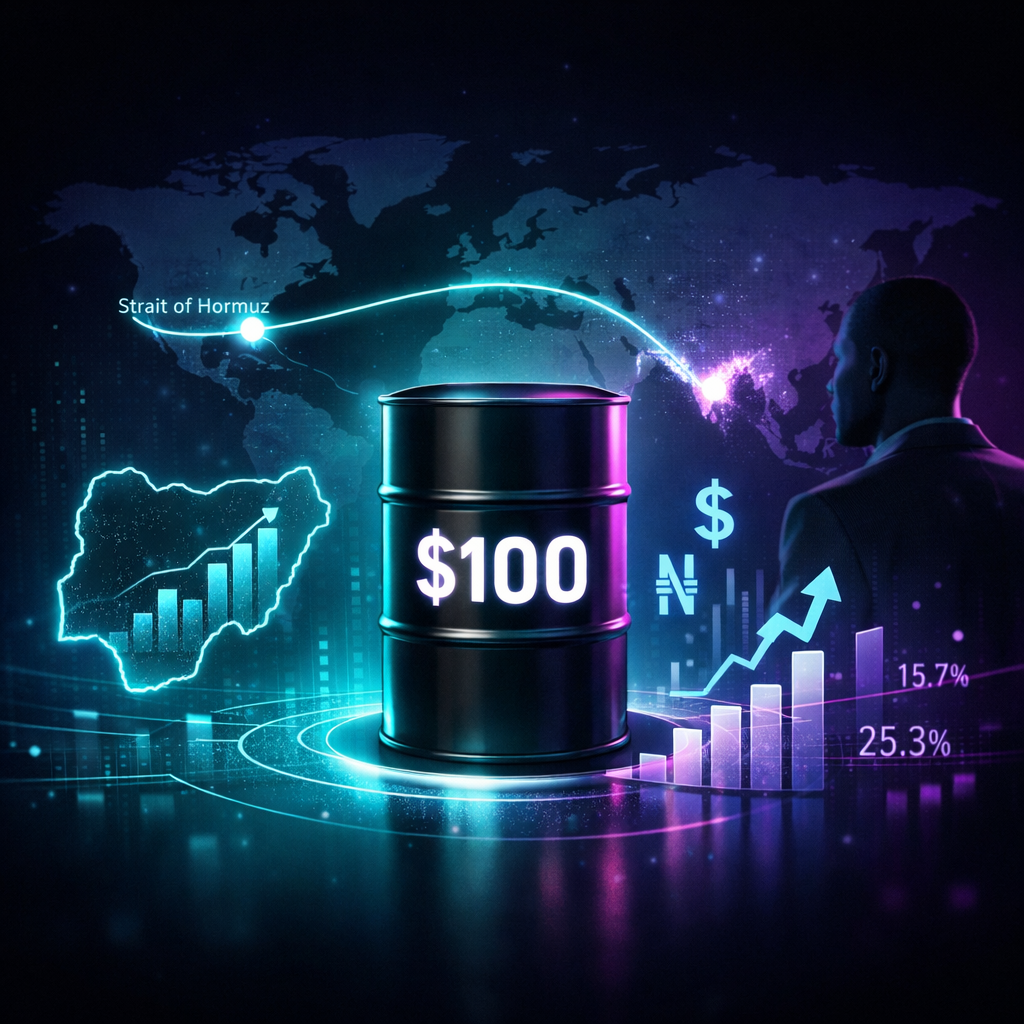
Can rising oil prices actually make an oil-rich country poorer?
🧠 Waides Feed
The world is once again watching the Strait of Hormuz — a narrow passage with the power to influence global energy prices. When tension rises here, oil prices follow. And when oil prices rise, countries like Nigeria are expected to benefit.
But that expectation is increasingly misleading.
Nigeria’s relationship with oil is not built on control, but on exposure. While the country exports crude oil, it depends heavily on importing refined fuel. This creates a fragile system where rising oil prices increase national earnings on one side, while simultaneously increasing national costs on the other.
As we will explore in our full breakdown of global energy systems, this is not just a pricing issue — it is a structural imbalance.
This is the core of the “Hormuz Ripple.”
The future is not shaped by resources alone, but by how systems are built around them.
💡 Why It Matters / Public Context
Higher oil prices do not automatically mean economic gain for Nigeria.
They can increase pressure on citizens faster than they increase national stability.
For everyday Nigerians, this means rising transport costs, higher food prices, and reduced purchasing power — even when oil revenue is increasing.
📘 What is the “Hormuz Ripple”?
The “Hormuz Ripple” refers to the chain reaction triggered when instability around the Strait of Hormuz pushes global oil prices higher.
For Nigeria, this ripple creates a paradox:
👉 More income from crude oil exports
👉 Even more spending on refined fuel imports
In simple terms:
Nigeria earns more… but spends even faster.
🌐 Real Examples / Current Use
- Rising global oil prices increasing Nigeria’s export revenue
- Higher fuel import costs driving domestic inflation
- Increased transportation and logistics costs affecting food prices
- Pressure on government budgets due to energy-related expenses
This reflects a broader trend seen in oil-dependent economies, where external shocks create internal instability.
As we will explore in our analysis of emerging market economies, reliance on external systems often turns advantage into vulnerability.
⚙️ How It Works / Why It Matters
Nigeria’s oil system operates in two directions:
- Export side: Crude oil sold globally → revenue increases when prices rise
- Import side: Refined fuel purchased globally → costs rise even faster
Because refining is largely external, Nigeria is exposed to global pricing on both ends.
Why this matters:
👉 The country does not fully control its oil value chain
This means oil becomes a double-edged system — generating income while simultaneously increasing economic pressure.
🕰️ Historical Context
This pattern is not new.
Many resource-rich countries have experienced similar cycles:
- High commodity prices create short-term optimism
- Structural weaknesses reduce long-term benefit
- External dependence limits real economic growth
Historically, this is known as the resource paradox — where abundance does not translate into stability.
🧬 KI Insight
According to KI analysis, Nigeria’s oil economy is not failing because of low prices, but because of structural imbalance.
The system is defined by:
- External pricing control
- Import dependence
- Revenue-cost mismatch
This creates a loop:
👉 Price increase → revenue rise → cost rise → inflation → reduced real benefit
From the perspective of Konsmik Civilization, this reflects a deeper truth:
A system that does not control its value chain cannot fully benefit from its resources.
Opportunities:
- Investment in domestic refining capacity
- Strengthening of foreign reserves
- Strategic restructuring of energy systems
Risks:
- Inflation across essential sectors
- Currency depreciation due to dollar demand
- Budget instability based on volatile oil prices
In Konsmik Civilization, oil would not be treated as raw export value alone, but as a fully integrated system — from extraction to refinement to distribution — ensuring that value remains within the system.
🌍 For Konsmik Civilization
In Konsmik Civilization:
- Resource control includes the full value chain
- External dependency is minimized
- Economic systems are designed for balance, not exposure
Step-by-step:
- Extract resources
- Process locally
- Distribute within a controlled system
Outcome:
A system where resource wealth translates into real stability.
🛠️ Solution Layer
Micro (Individual):
- Adapt spending to inflation realities
- Build financial resilience
Meso (Community):
- Support local production and distribution systems
- Encourage alternative energy awareness
Macro (Government):
- Invest in refining infrastructure
- Reduce dependence on fuel imports
- Diversify economic revenue beyond oil
- Stabilize currency through strategic reserves
🌌 Konsmik Reality
Oil is not just wealth.
It is a test.
A test of whether a nation controls its resources…
or is controlled by the systems around those resources.
Nigeria is not poor in oil.
It is exposed in structure.
🔮 Forecast
Short-Term (1–2 years):
- Oil price volatility continues
- Inflation pressure increases
- Budget strain despite higher revenue
Medium-Term (3–5 years):
- Push toward local refining capacity
- Gradual restructuring of energy systems
- Reduced dependency if reforms are sustained
Long-Term (5–10 years):
- Nigeria either becomes energy-independent
- Or remains vulnerable to global price shocks
❓ FAQ
Why is $100 oil not good for Nigeria?
Because higher prices increase both revenue and costs, often raising inflation more than income.
What is the main problem in Nigeria’s oil system?
Dependence on importing refined fuel.
Can Nigeria benefit from high oil prices?
Yes, but only if it controls more of the oil value chain.
What is the Hormuz Ripple?
It is the global impact of oil price increases caused by instability around a key oil route.
🧠 Closing Impact
The real question is not whether oil prices rise.
It is whether Nigeria is structured to benefit when they do.
🌍 Reflection Question
If a country produces wealth but cannot fully control it,
is it truly benefiting from its resources… or just participating in someone else’s system?






Leave a Reply