

🧠 Waides Feed
A new economic force is quietly reshaping the world—not through natural resources or industrial power, but through intelligence.
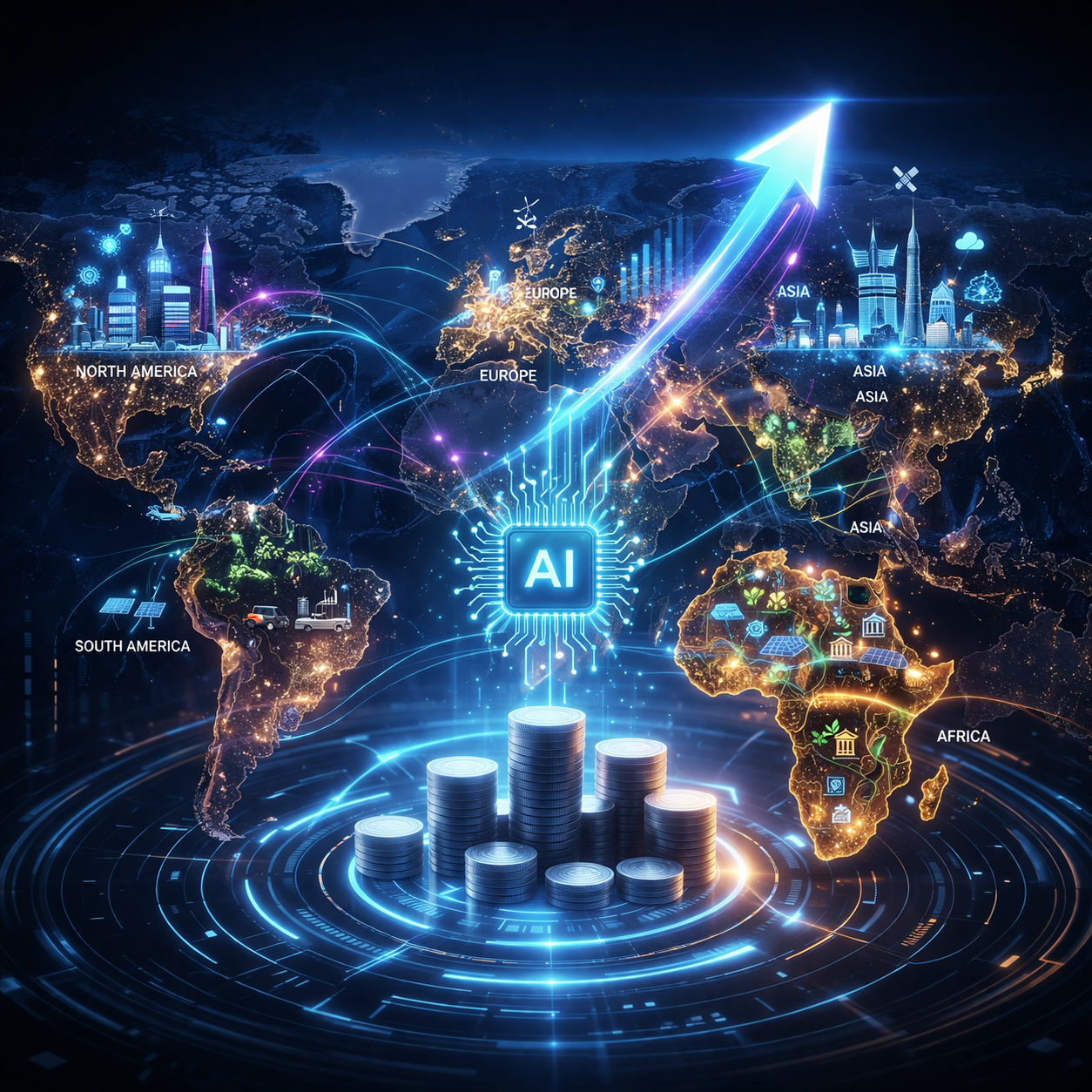
The global surge in AI investment is not just about funding startups. It is about building the operating system of the future economy. From Silicon Valley to China, from Europe to emerging hubs in Africa and Southeast Asia, capital is moving toward one destination: systems that can think, decide, and optimize at scale.
This shift reflects a deeper transformation already unfolding across global systems. Intelligence is becoming infrastructure. As this pattern expands, economies are no longer competing only on production or labor, but on their ability to build and control intelligent systems that guide decision-making, automate industries, and influence behavior.
Across regions, the impact is uneven but interconnected. The United States and China are accelerating dominance through capital and infrastructure. Europe is focusing on regulation and ethical AI frameworks. Asia, particularly countries like India, Singapore, and South Korea, is rapidly scaling talent and digital ecosystems. Africa, on the other hand, stands at a pivotal moment—positioned between opportunity and dependency.
The future is not being built in isolation. It is being shaped through a global race for intelligence.
💡 Why It Matters (Silver Platter)
AI investment is redefining which regions will lead the global economy—and which will follow.
This is not just a technology shift; it is a restructuring of global power, opportunity, and control.
For individuals:
- Job structures will evolve rapidly
- Skills tied to AI will become essential
- Economic opportunities will shift toward digital and intelligent systems
For regions:
- Some will gain dominance
- Others risk becoming dependent users of foreign AI systems
🤖 What is the AI Investment Boom?
The AI investment boom refers to the massive flow of capital into companies and systems that develop artificial intelligence technologies.
These include:
- Automation platforms
- Machine learning systems
- Generative AI tools
- Data intelligence infrastructure
In simple terms:
👉 Investors are funding systems that can replace, enhance, or guide human decision-making.
🌐 Real Examples / Current Use
The impact of AI investment is already visible across continents:
- United States: Leading in AI model development, cloud infrastructure, and startup funding
- China: Rapidly integrating AI into surveillance, manufacturing, and national systems
- Europe: Prioritizing ethical AI regulations and governance frameworks
- Asia (India, Singapore, South Korea): Scaling AI talent, fintech systems, and smart city innovations
- Africa (Nigeria, Kenya, South Africa): Emerging AI startups in fintech, agriculture, and health systems
This reflects a broader global pattern where intelligence systems are becoming central to economic growth and competitiveness.
⚙️ How It Works / Why It Matters
The logic behind this investment wave is simple:
AI increases efficiency while reducing dependency on human labor.
For businesses:
- Faster decision-making
- Lower operational costs
- Scalable growth
For investors:
- Higher returns
- Long-term control over systems
But beneath this lies a deeper reality:
AI is not just a tool—it is becoming the infrastructure that powers entire economies.
Countries and companies investing early are not just gaining advantage—they are shaping the rules of future economic interaction.
🕰️ Historical Context
Global power has always followed control over key systems:
- Industrial Era → Control of machines and factories
- Information Era → Control of data and networks
- Digital Era → Control of platforms and ecosystems
Now:
👉 AI Era → Control of intelligence systems
History shows that those who control foundational systems often define global influence for decades.
🧬 KI Insight
According to KI analysis, the AI investment boom is accelerating a shift toward an intelligence-driven global hierarchy.
Capital is not flowing evenly—it is concentrating in regions and companies with existing advantages.
Opportunities:
- Rapid innovation across sectors globally
- Economic leapfrogging for emerging regions like Africa and parts of Asia
- Creation of new industries and job categories
Risks:
- Increased inequality between AI-leading and AI-dependent regions
- Loss of data sovereignty for developing economies
- Job displacement in labor-heavy sectors
From a human-centered perspective, this is a moment of decision:
👉 Will intelligence systems empower humanity broadly, or centralize power narrowly?
🌍 For Konsmik Civilization
In Konsmik Civilization, the intelligence economy is structured differently.
AI systems are:
- Distributed across regions, not concentrated
- Built with ethical governance at their core
- Designed to enhance human potential rather than replace it
Regions like Africa and Asia are not left behind—they are integrated as equal contributors.
This creates a balanced system where:
👉 Intelligence becomes a shared resource, not a controlled asset
🛠️ Solution Layer
Micro (Individual):
- Learn AI-related skills
- Adapt to hybrid human-AI workflows
Meso (Business):
- Integrate AI strategically
- Invest in local talent development
Macro (Global & Regional):
- Build local AI ecosystems in Africa and Asia
- Develop policies to protect data sovereignty
- Encourage equitable distribution of AI infrastructure
🌌 Konsmik Reality
From the lens of Konsmik Reality, this shift is not just economic—it is existential.
Humanity is transitioning from a world defined by physical output to one defined by cognitive systems.
AI investment is the signal:
👉 Intelligence is becoming the new currency of power
The imbalance we see today is not permanent—but it is shaping the trajectory of global civilization.
The deeper question is not who invests the most, but who builds systems that serve humanity.
🔮 Forecast
Short-term (1–2 years):
AI investment continues to surge globally, with rapid adoption across industries
Medium-term (3–5 years):
Clear divide emerges between AI-leading regions and dependent economies
Long-term (5–10 years):
AI becomes deeply embedded in governance, economy, and daily life across all continents
❓ FAQ
What is the AI investment boom?
It is the massive funding of artificial intelligence startups and systems globally.
Why is AI important for the global economy?
Because it increases efficiency, reshapes industries, and defines future economic power.
How does this affect Africa and Asia?
It creates both opportunities for growth and risks of dependency on foreign systems.
Will AI replace jobs globally?
Some jobs will be replaced, but new roles will also emerge.
🧠 Closing Impact
This is not just a moment of innovation—it is a moment of alignment.
Nations, businesses, and individuals are being positioned within a new system where intelligence defines relevance.
Understanding this shift is no longer optional—it is essential.
🌍 Reflection Question
Will Africa, Asia, and the rest of the world become creators of intelligence systems…
or remain users of systems designed elsewhere?






Leave a Reply