

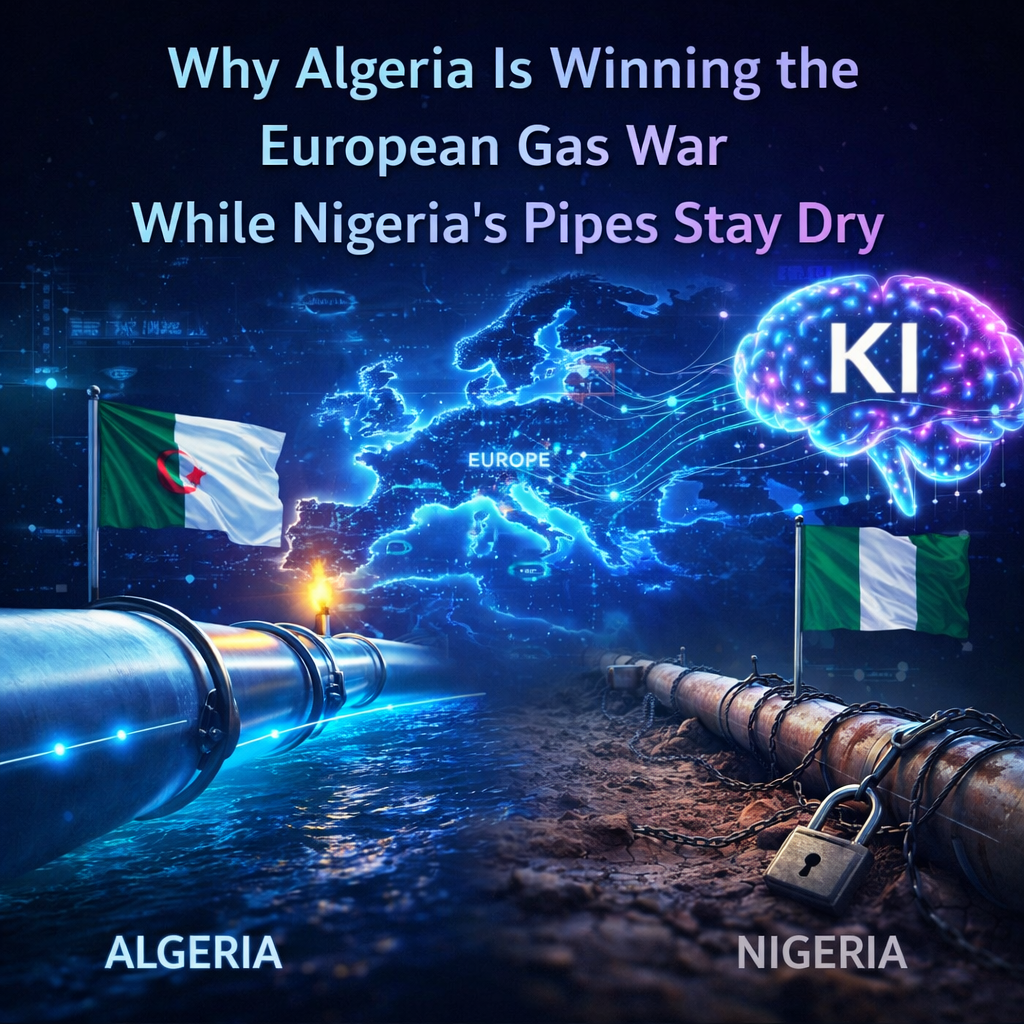
What if the real power in the energy world isn’t who has the most gas… but who can deliver it first?
🧠 Waides Feed
Across Europe’s evolving energy landscape, a quiet shift in power is taking place. As the continent moves away from traditional suppliers, new partners are stepping in. Among them, Algeria has emerged as a reliable and immediate source of natural gas.
But the story is not just about Algeria’s rise. It is also about Nigeria’s delay.
Nigeria holds vast gas reserves, often seen as one of Africa’s strongest energy advantages. Yet, despite this potential, its ability to supply Europe remains limited. The reason is not the absence of resources, but the absence of efficient delivery systems.
As we will explore in our deeper breakdown of global energy infrastructure dynamics, energy markets reward certainty, speed, and reliability — not just capacity.
This is where the gap appears.
Algeria is already connected to Europe through pipelines that deliver gas directly and consistently. Nigeria, on the other hand, is still navigating delayed projects, security concerns, and infrastructural gaps.
This is not a resource problem.
It is a system problem.
The future of energy will not belong to those who have the most…
but to those who can move it best.
💡 Why It Matters / Public Context
Energy advantage is no longer defined by what you own, but by how quickly you can deliver it.
Nigeria’s challenge is not scarcity — it is access.
For everyday citizens, this translates into missed economic opportunities, reduced national revenue potential, and slower development despite resource wealth.
📘 What is the European Gas Shift?
Europe is restructuring its gas supply system due to geopolitical changes and the need for diversified energy sources.
This shift involves:
- Reducing dependence on traditional suppliers
- Increasing reliance on nearby and reliable sources
- Prioritizing infrastructure-ready partners
In simple terms:
👉 Europe is choosing who can deliver now, not who might deliver later.
🌐 Real Examples / Current Use
- Algeria supplying gas directly to Europe through established pipelines
- Long-term energy agreements being secured with reliable exporters
- Nigeria relying more on LNG exports rather than direct pipeline supply
- Delays in major pipeline projects linking Nigeria to Europe
This reflects a broader global pattern where infrastructure readiness determines economic advantage.
As we will explore in our analysis of global supply chain systems, delivery speed often outweighs resource volume.
⚙️ How It Works / Why It Matters
There are two main ways gas reaches markets:
- Pipeline Gas:
- Direct
- Continuous
- Lower long-term cost
- LNG (Liquefied Natural Gas):
- Flexible
- Requires shipping and regasification
- Higher logistical complexity
Algeria benefits from pipelines.
Nigeria relies heavily on LNG.
Why this matters:
👉 Pipelines provide speed and stability, giving Algeria a competitive edge.
🕰️ Historical Context
Energy systems have always followed a clear pattern:
- Early infrastructure investment leads to long-term dominance
- Late entry results in missed opportunities
Countries that built connections early secured lasting influence.
This is the same pattern now playing out in Africa’s gas sector.
🧬 KI Insight
According to KI analysis, the difference between Algeria and Nigeria is not resource availability, but infrastructure readiness and system execution.
The global energy system operates on a simple principle:
👉 Value is realized only when it can move
Algeria controls its delivery pathways.
Nigeria is still developing them.
From the perspective of Konsmik Civilization, this reflects a deeper systemic truth:
👉 Ownership without access creates illusion, not advantage
Opportunities:
- Accelerated development of pipeline infrastructure
- Strategic partnerships with Europe and regional actors
- Expansion of LNG as an interim solution
Risks:
- Loss of long-term contracts to competitors
- Underutilization of natural gas reserves
- Continued economic inefficiency
- Reduced influence in global energy markets
In Konsmik Civilization, energy systems would be fully integrated — ensuring that extraction, transportation, and distribution operate as a unified flow.
🌍 For Konsmik Civilization
In Konsmik Civilization:
- Resources are connected to markets through efficient systems
- Infrastructure is prioritized alongside extraction
- Value chains are complete and controlled
System flow:
- Extract
- Transport
- Deliver
Outcome:
A system where potential becomes reality.
🛠️ Solution Layer
Micro (Individual Awareness):
- Understanding how national systems affect economic outcomes
Meso (Regional):
- Strengthening African energy cooperation
- Developing shared infrastructure projects
Macro (Government):
- Investing in pipeline development
- Addressing security concerns along transit routes
- Building long-term strategic energy partnerships
- Diversifying energy export methods
🌌 Konsmik Reality
Resources alone do not create power.
Connection creates power.
Nigeria is not lacking gas.
It is lacking the pathways to transform that gas into influence.
🔮 Forecast
Short-Term (1–2 years):
- Algeria maintains dominance in European gas supply
- Nigeria continues relying on LNG exports
Medium-Term (3–5 years):
- Potential acceleration of pipeline projects in Nigeria
- Increased competition among African exporters
Long-Term (5–10 years):
- Nigeria either becomes a major pipeline supplier
- Or remains a resource-rich but underconnected economy
❓ FAQ
Why is Algeria ahead in gas exports?
Because it has established pipeline infrastructure directly connected to Europe.
Does Nigeria have more gas than Algeria?
Nigeria has significant reserves, but lacks delivery systems.
What is Nigeria’s main challenge?
Infrastructure and project execution.
Can Nigeria compete in the future?
Yes, if it develops efficient transport systems.
🧠 Closing Impact
The global energy race is not about possession.
It is about movement.
🌍 Reflection Question
If a nation holds wealth but cannot deliver it,
is it truly rich… or just waiting to be?








Leave a Reply