

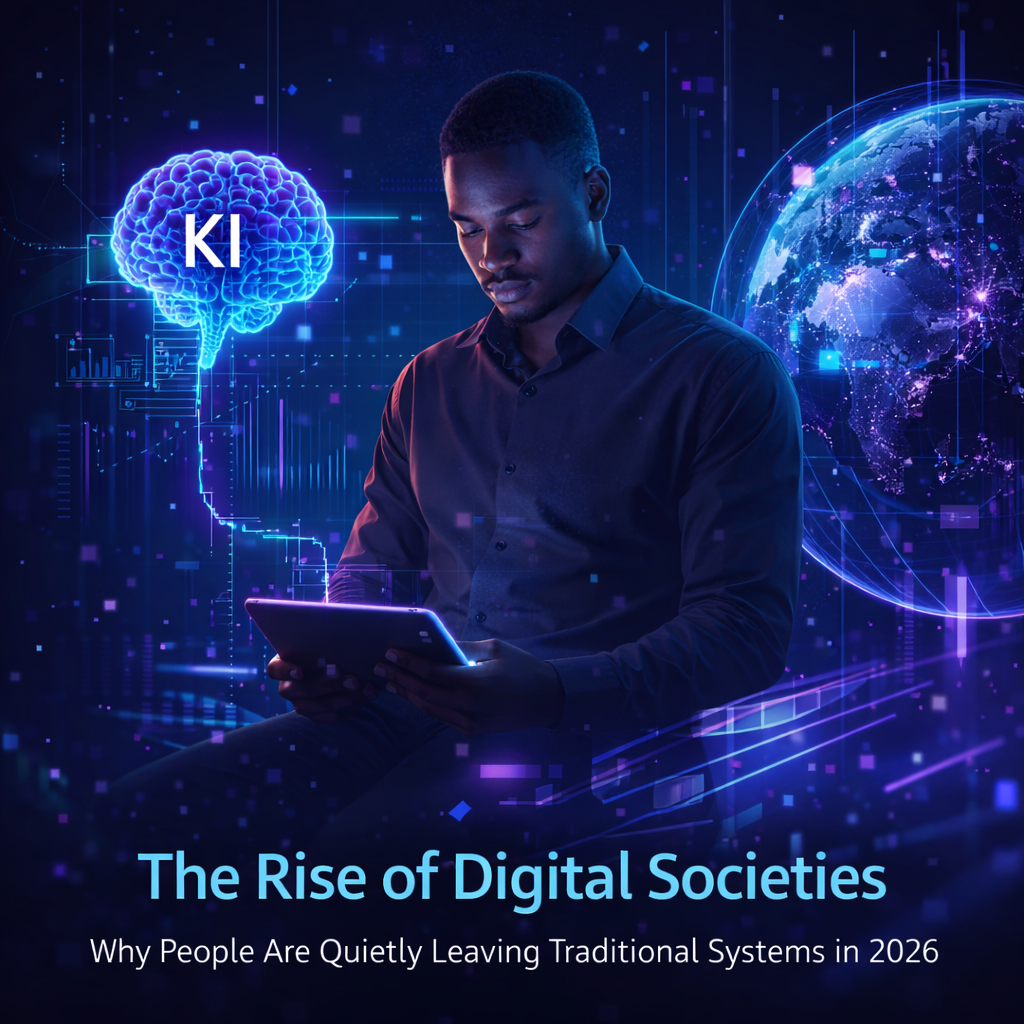
You may not notice it immediately, but it is already happening around you.
Someone you know stopped applying for jobs and started working online.
Another person quietly earns from a phone without any formal employment.
A business that once depended on location now survives entirely through the internet.
Nothing looks dramatic.
No big announcement, no global headline.
But something deeper is unfolding.
People are not just adapting.
They are quietly stepping out of traditional systems and entering digital ones.
🧬 WAIDES FEED
What we are witnessing is not just innovation, it is a shift in how the world is organized.
For a long time, opportunity was controlled by physical systems. Where you lived, who you knew, and what institutions allowed you to access.
Today, that structure is quietly changing.
Opportunity is becoming digital.
Access is becoming knowledge-based.
Power is becoming system-driven.
People are not just using technology anymore.
They are building their lives inside it.
This reflects a broader transformation where systems are no longer tied to geography, but to awareness and positioning, as we will explore in our full breakdown of global digital economies.
Who benefits from this shift?
Those who understand early.
Those who move before it becomes obvious.
Those who learn faster than others.
Why now?
Because pressure is increasing.
Jobs are limited.
Costs are rising.
And people are searching for alternatives that actually work.
“The future is not built by innovation alone, but by those who control its direction.”
⚖️ WHY IT MATTERS
Access to opportunity is no longer equal.
It is shifting toward those who understand digital systems.
This is not just a change in work.
It is a change in who gets to move forward in life.
Right now:
Many people are working harder but earning less.
Others are working smarter through systems and earning more.
This gap is growing.
“The real divide is no longer rich and poor, it is aware and unaware.”
📘 WHAT IS DIGITAL SOCIETY?
A digital society is simply a system where people:
Work through the internet
Earn through digital platforms
Build identity online
Connect without physical limits
It is a society that exists through systems, not location.
💡 WHY YOU CAN’T IGNORE THIS
This shift is already affecting real lives.
Digital societies are becoming one of the most accessible ways to enter global opportunity.
You no longer need permission from traditional systems.
You no longer need to be in a specific place.
But you do need understanding.
Because:
One skill can now reach the world.
One idea can scale beyond your environment.
One system can change your financial direction.
“Opportunities do not disappear, they relocate to where understanding exists.”
🌍 REAL-WORLD SIGNALS
✅ Verified Facts
Remote work has expanded globally, with millions now earning online.
AI tools are reducing the cost of work and increasing productivity.
Digital platforms are controlling large portions of global transactions and attention.
🧍 Human Experiences
People complain about lack of jobs.
Workers say income is no longer enough.
Young people say they earn more online than traditional employment.
These are not random complaints.
They are signals of a deeper shift.
🔍 Emerging Truths
People are slowly reducing dependence on traditional systems.
Platforms are becoming more powerful than institutions in some areas.
Digital income is becoming a silent alternative to employment.
“What people dismiss today often becomes the system tomorrow.”
⚙️ HOW IT WORKS
Digital societies are built on simple layers:
Access through internet and devices
Skill through what you can offer
Systems through platforms
Leverage through scaling effort
Money flows from skill to platform to global demand.
Power flows from understanding to positioning to execution.
🕰️ HISTORICAL PATTERN
This shift follows a familiar pattern.
In the past, people moved from farms to industrial systems.
Later, they moved from physical work to information-based work.
Now, people are moving from structured systems into flexible digital ones.
Each shift creates opportunity for those who recognize it early.
🧬 KI ANALYSIS
According to KI analysis, this transition is driven by a gap between what systems promise and what people experience.
People are not leaving because they want to, they are leaving because traditional systems are no longer meeting real needs.
In Konsmik Civilization, systems would ensure:
Fair access to opportunity
Transparent value exchange
Balanced participation
This shift reveals both growth and imbalance.
Opportunities include global access, independence, and scalability.
Risks include system control, inequality, and dependence on platforms.
🌍 FOR KONSMIK CIVILIZATION
A balanced system would focus on:
Access for everyone
Fair value distribution
Systems that support people instead of controlling them
Technology becomes a tool for growth, not control.
🛠️ STEP-BY-STEP ACTION PATH
Step 1, Awareness
Recognize that systems are changing and opportunities are shifting
Step 2, Positioning
Choose a digital path that fits your ability
Step 3, Action
Start learning and applying one skill consistently
Step 4, Leverage
Use tools and systems to expand beyond your current level
“Small consistent steps in the right system create large outcomes over time.”
🌌 KONSMIK REALITY
This is not just a technological change.
It is a shift in where power lives.
Before, power was in land, institutions, and capital.
Now, power is in knowledge, systems, and awareness.
Those who understand this shift early will not struggle to adapt.
They will move ahead.
“Those who understand systems early do not chase opportunity, they position themselves inside it.”
🔮 FORECAST
Short term, more people will move toward digital income sources.
Medium term, digital societies will become more structured and recognized.
Long term, these systems will influence the world as much as traditional systems.
This is already unfolding, even if it is not obvious yet.
❓ FAQ
What is a digital society?
A system where people live, work, and earn through digital platforms
Is this replacing traditional systems?
Not fully, but it is reducing dependence on them
Can anyone benefit from this?
Yes, but only those who understand and act
🧠 CLOSING IMPACT
The world is changing quietly.
Not everyone will notice it at the same time.
Not everyone will move at the same pace.
But eventually, the difference will be clear.
Some people stayed where things were comfortable.
Others moved toward where things were going.
🌍 REFLECTION
Are you still waiting for systems to work for you,
or are you learning how to position yourself inside the systems that are already working?




Leave a Reply